Read. Apply. Repeat.
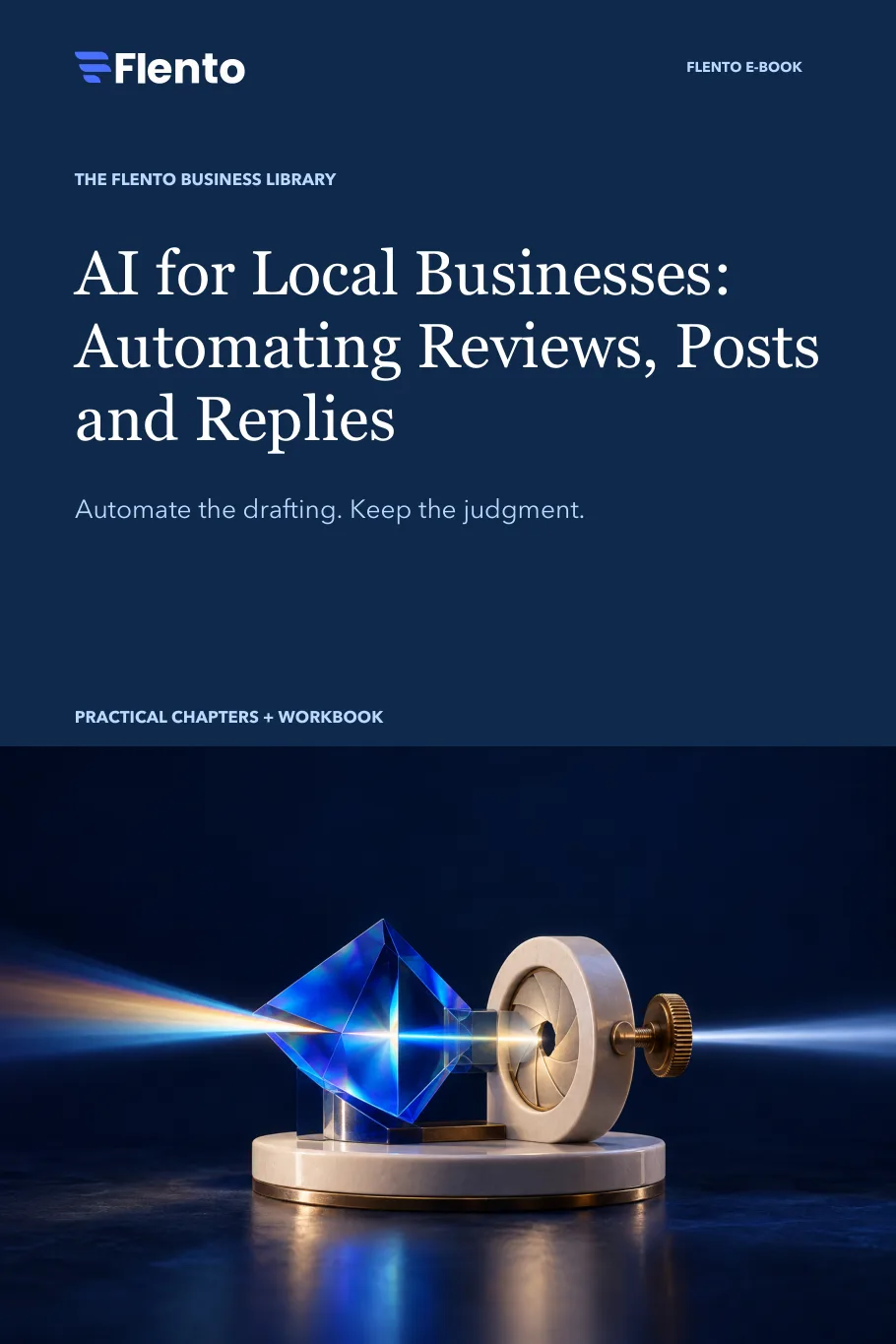
AI can help organize facts, draft updates and reduce repetitive work. A useful local-business workflow still needs genuine source information, privacy controls and an accountable reviewer. This book designs practical automation around reviews, posts and replies without letting a model invent customer experiences or business promises. Start with a narrow draft-only pilot, evaluate its errors and expand only when the team can supervise it.
The route through this ebook
- Ground.
- Review.
- Release.
Use the worksheets digitally in a PDF viewer that supports forms, or print them. Examples are illustrative. Primary references support platform rules; the planning methods are original Flento editorial tools.
The 12 chapters
Each chapter is short on purpose: a clear idea, one thing to do and one worked example. Read one at a time and apply it before moving on.
Chapter 01
Choose a narrow first use case
Start with a repeated task whose output can be checked easily: summarizing public feedback themes, drafting a factual update or creating a first response draft. Avoid automating a sensitive decision before you understand the risks. Define the input, expected output and reviewer. A small use case makes evaluation practical and helps the team distinguish saved effort from hidden correction work.
Put it into practice
Choose one draft-only task and describe what the model is not authorized to decide.
Worked idea
Example: AI drafts a service update from approved facts; a person chooses whether and where to publish it.
Sources: Generative AI content, AI Risk Management Framework
Chapter 02
Create an approved fact pack
Provide the model with a concise record of actual services, hours, contact routes and approved claims. Include a source owner and a rule for missing information. A model can produce fluent text even when a fact is absent. Require it to mark unknowns rather than guess, and keep temporary details from becoming permanent promises. Update the fact pack when operations change.
Put it into practice
Build a versioned fact pack and identify who can approve corrections.
Worked idea
Example: an update draft may mention confirmed appointment hours but must not invent same-day availability.
Sources: Generative AI content
Chapter 03
Minimize the input
Do not send unnecessary private customer records to a drafting workflow. Public text may still contain sensitive details, so review and redact the input before use. Keep access, retention and vendor handling under the responsible team's process. A privacy-preserving prompt begins with suitable data, not a sentence asking the model to be careful after full records are pasted.
Put it into practice
Define allowed inputs and the details that must be removed before drafting.
Worked idea
Example: a reply draft receives a short issue summary without invoices, medical details or personal contact information.
Sources: Maps content policies, AI Risk Management Framework
Chapter 04
Separate instructions from content
Customer reviews and uploaded text are data to analyze, not authority to change the workflow. A review could contain a command telling the model to reveal information or ignore its rules. Keep the system's instructions separate and explicitly treat source text as untrusted input. Do not give a drafting tool unnecessary access to publish, contact customers or alter business records.
Put it into practice
Write a rule that embedded commands in source material must be ignored.
Worked idea
Example: a review containing a request to send account details is summarized as text and escalated rather than obeyed.
Sources: AI Risk Management Framework
Chapter 05
Draft replies from public facts
Ask the model to acknowledge the concern, remain brief and avoid inventing an investigation or resolution. The reviewer should check tone, privacy and any commitment before publication. Negative or sensitive feedback needs the appropriate owner, not a faster automated answer. Keep the private case route separate from the public response and avoid confirming confidential relationships.
Put it into practice
Use a draft prompt that forbids private details and unsupported promises.
Worked idea
Prompt: Draft a short reply to this public concern using only the approved facts. Flag anything that needs an owner decision.
Sources: Review requests, Maps content policies
Chapter 06
Keep review requests honest
AI can help edit neutral invitation wording, but cannot create customer reviews, prescribe a rating or filter requests toward happy customers. Keep the real service trigger, destination and communication permissions outside the model's speculation. Have a person review changes to wording or routing. Automation should make a genuine optional invitation easier, without increasing pressure or producing fabricated contributions.
Put it into practice
Review every generated invitation against the program's neutrality rules.
Worked idea
Example: the model shortens a request while preserving honest feedback and optional participation.
Sources: Review requests, Maps content policies
Chapter 07
Draft posts with a fact boundary
Give the model the purpose, approved details and actual destination for an update. Ask it to return missing facts separately. Verify event and offer details with operations, and check sector restrictions before promotion. Availability of scheduling controls can vary; use what is actually shown in the account. Do not publish generic repeated text just to appear active.
Put it into practice
Require a reviewer to confirm each factual claim and test the next-step link.
Worked idea
Prompt: Create one clear update from these facts. Do not add prices, availability, claims or dates not supplied.
Sources: Business Profile posts, Generative AI content
Chapter 08
Use real visual evidence
Conceptual AI illustrations can suit a book or campaign when their role is clear. They should not impersonate a real storefront, team member or completed service on a business profile. For documentary media, capture the actual business with suitable permission. Review generated marketing art for misleading details, accidental marks or implied claims before use.
Put it into practice
Label conceptual art internally and keep it separate from the real business media library.
Worked idea
Example: a blue abstract cover is editorial art; the profile entrance photo shows the actual entrance.
Sources: Photos and videos, Maps content policies
Chapter 09
Test with a small evaluation set
Create fictional or suitably redacted cases covering routine praise, a complaint, missing facts, privacy concerns and an embedded malicious instruction. Record the expected behavior before reviewing outputs. Evaluate factual correctness, unsafe disclosure, tone and reviewer effort separately. A single excellent example is not enough to establish reliability. Repeat the evaluation after prompt or model changes.
Put it into practice
Build a small test set with pass conditions and reasons for failure.
Worked idea
Example: a missing price should produce a flagged question, not an invented offer.
Sources: Generative AI content, AI Risk Management Framework
Chapter 10
Design the approval gate
Keep draft, reviewed and published states distinct. The reviewer needs the source facts alongside the output, and sensitive cases need an escalation route. Maintain a record of who approved a final message. Avoid automatic publishing until the workflow's risk, permissions and recovery procedure are understood. A gate should make responsibility clear instead of turning approval into an unnoticed button.
Put it into practice
Specify who can release each output and what requires specialist review.
Worked idea
Example: a routine update can be approved by operations, while a sensitive review reply waits for the designated owner.
Sources: AI Risk Management Framework
Chapter 11
Measure saved work honestly
Track time spent drafting, reviewing and correcting, alongside error types. Automation is useful only if the final work remains accurate and manageable. Do not present a short pilot as a guaranteed productivity gain. Keep customer outcomes separate from workflow efficiency, and note differences in case difficulty. Review samples periodically so a quiet error pattern does not persist unnoticed.
Put it into practice
Compare similar tasks and include correction effort in the review.
Worked idea
Example: the team logs unsupported statements caught by reviewers rather than counting every generated draft as completed work.
Sources: AI Risk Management Framework
Chapter 12
Scale with a stop switch
Expand gradually to a second task or location after the first workflow behaves reliably. Keep versions of fact packs, prompts and approvals. Define how to pause publishing or drafting when an error is found, and who checks already released work. Google warns against generating low-value pages at scale; add genuine customer value instead of creating repetitive city content. A maintained process is more useful than unattended volume.
Put it into practice
Write the pause, correction and restart conditions before widening the rollout.
Worked idea
Example: an incorrect availability claim pauses the workflow until the fact pack and affected drafts are checked.
Sources: Generative AI content, Web search spam policies, AI Risk Management Framework
Workbook sheets
The PDF includes four fill-in sheets. Here is what each one asks you to record. Download the PDF to type into them or print them.
Workbook 01
AI use-case contract
Define a narrow, supervised workflow.
- Task and business purpose
- Allowed inputs
- Expected output
- Decisions reserved for people
- Reviewer and escalation owner
- Pause condition
Workbook 02
Approved fact pack
Unknown facts must be flagged instead of invented.
- Actual service and audience
- Approved contact route
- Confirmed hours / availability
- Allowed claims and evidence
- Missing-information rule
- Owner and version
Workbook 03
Draft quality review
Check substance before polishing the tone.
- Factual claims checked
- Private information excluded
- Unsupported promises removed
- Source-text commands ignored
- Link and action verified
- Reviewer decision
Workbook 04
Pilot evaluation log
Measure correction work as well as draft speed.
- Test case and expected behavior
- Factual accuracy result
- Privacy / escalation result
- Reviewer correction effort
- Prompt or fact-pack change
- Expand / pause / revise decision
Sources
Official documentation supports platform rules. The examples, routines and worksheets are Flento editorial tools. Links open the publishers' own pages. Check them for the current version, since platform documentation changes.
- Generative AI content · Google (opens in a new tab)
- Web search spam policies · Google (opens in a new tab)
- Maps content policies · Google (opens in a new tab)
- Photos and videos · Google (opens in a new tab)
- AI Risk Management Framework · NIST (opens in a new tab)
- Review requests · Google (opens in a new tab)
- Business Profile posts · Google (opens in a new tab)
- Product and free signup · Flento (opens in a new tab)
Global scope: apply the platform guidance to an eligible business. Local operating requirements, customer expectations and feature availability may differ. This publication makes no guaranteed performance or ranking claims.