Be easy to find. Be clear enough to choose.
Local discovery works best when the right customer can understand the real restaurant.
The industry decision
The customer needs to understand whether the menu, seating and service times fit the occasion. Separate table reservations, dine-in service and takeaway orders where these are genuinely offered. Give each route a clear description of who it suits and how the next step works.
The benchmark discipline
This report sets operational standards and a repeatable way to compare your restaurant with relevant local peers. It combines official platform guidance with Flento’s industry recommendations. Benchmark here means a defined comparison method; the report does not claim observed global averages or an analysed sample of restaurants.
1. Evidence and the business model
What This Report Benchmarks
Three kinds of evidence. One honest comparison.
Use each evidence type for the question it can answer.
Platform requirements
Google documents profile eligibility, representation rules and performance definitions. These define what information belongs on the profile and how supported metrics should be interpreted.
Industry context
Google’s category guidance explains how a profile should describe what the real business is. Flento’s segmentation and customer-decision standards apply this platform context to restaurants; they are editorial recommendations, not observed industry medians or an industry ranking experiment.
Your comparison data
Use your own restaurant records and a defined local-peer set to calculate a baseline. Flento’s scorecard, test plan and illustrative calculation are operating tools. They are not measured market findings.
Sources: Business representation and industry rules, Business Profile eligibility, Categories and industry identity
Local Ranking Fundamentals
Relevance. Distance. Prominence.
Google documents the core local-ranking factors; Flento applies them to restaurants.
The documented factors
Relevance concerns the match between the business and the search. Distance depends on the searcher’s location. Prominence concerns how well known the business is, including links and reviews. Google does not sell a better local ranking or publish precise algorithm weights.
Build the right segment
Segment restaurants by the actual operating model, customer need and service scope. Use restaurants with comparable cuisine, dining format and service model as a starting point. Record meaningful differences before treating two locations as interchangeable. Make the actual offer understandable and the business information accurate. Compare observations under consistent conditions; a larger service area or a publishing schedule does not establish a guaranteed ranking improvement.
Sources: Local ranking guidance
Profile Eligibility
Represent the real business and the real customer contact.
A local profile should match the way the business actually operates.
The documented rule
Google’s eligibility guidance generally requires in-person customer contact. Online-only businesses and lead-generation businesses are not eligible. A rented mailing address does not become a staffed customer-facing branch.
Apply it to this industry
Keep the actual location or territory, language and customer-contact arrangement consistent. For restaurants, table capacity, kitchen windows and booking availability can differ by market and location. Explain local arrangements precisely and verify which Google profile features apply to this model. Confirm the real-world model before adding an address, service area or separate profile. Use practitioner, department or multi-location rules only where their conditions are actually met.
Sources: Business representation and industry rules, Business Profile eligibility, Service-area businesses
2. Customer intent and useful proof
The Customer Journey
Discovery. Evaluation. An appropriate next step.
Flento journey model: measure the decision, then the fulfilled reservation or recorded sale.
Discover
Test queries such as “restaurants near me”. Record the search location, language and surface. The same business can appear differently under different conditions.
Evaluate
Explain whether the menu, seating and service times fit the occasion. State the actual inclusions and important limitations in plain language. Keep the public description consistent with the team’s live information. Distinguish an enquiry, a request and a confirmed commitment; these may be different stages.
Act
Connect suitable customer actions to a fulfilled reservation or recorded sale. Separate repeat customers, duplicate enquiries, rejected requests, cancellations and missing records where appropriate. A profile click or request alone does not establish the completed result.
Search Intent
Match the answer to the customer’s question.
Illustrative query families; validate the language with your own customers.
| Subject | Detail | Consideration |
|---|---|---|
| restaurants near me | Table reservations | Show who it suits and a clear next step. |
| dine-in service nearby | Dine-in service | Explain scope and available booking or enquiry route. |
| takeaway orders in my area | Takeaway orders | Clarify location, availability and any important conditions. |
| Business name + location | Brand or repeat visit | Keep the correct branch and contact destination obvious. |
Service Clarity
A useful service description reduces unsuitable enquiries.
Flento editorial standard for the restaurant website and customer-facing profile.
Describe the actual offer
Explain whether the menu, seating and service times fit the occasion. State the actual inclusions and important limitations in plain language. Keep the public description consistent with the team’s live information. Distinguish an enquiry, a request and a confirmed commitment; these may be different stages.
Give each service a purpose
Distinguish table reservations, dine-in service and takeaway orders wherever these are genuinely offered. A page should explain its own customer need, scope and next step. Do not create additional profiles merely to represent service keywords.
The Experience In View
Show what the customer can actually expect.
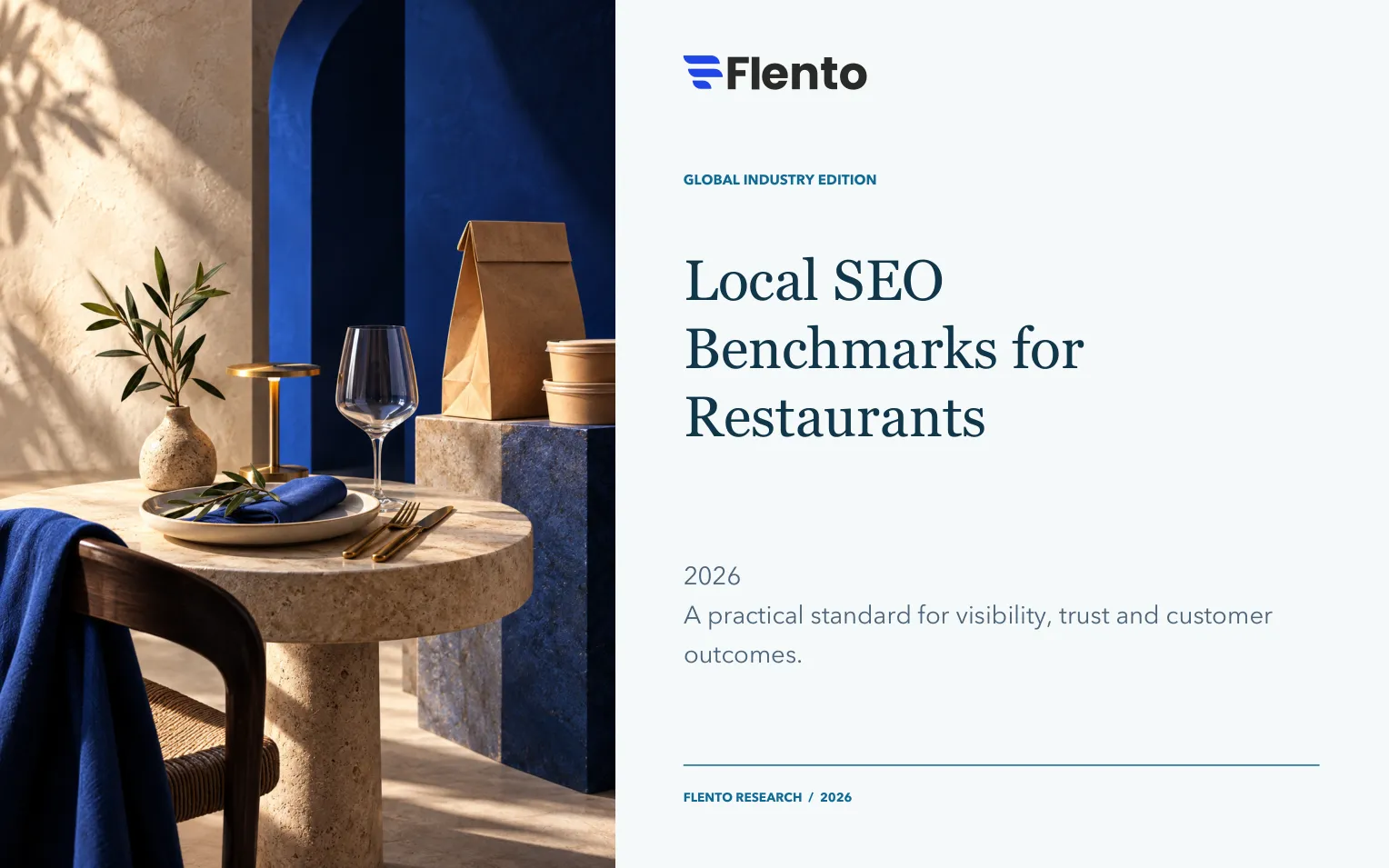
Original conceptual artwork accompanies a practical evidence checklist.
Choose useful proof
Useful evidence includes actual dishes, current menu and truthful seating arrangements. Attribute examples accurately and retain permission where people, private premises or client work are involved. A photograph or credential should answer a customer question rather than imply a result the business cannot substantiate.
Check before publishing
For a real Business Profile, use photographs of the actual business, products or service. Check accuracy, permission and confidential details. The conceptual image in this report is editorial artwork, not a real customer location or evidence of an outcome.
Sources: Photos and videos, Maps content policies
3. Trust and the conversion path
Trust And Suitability
Make the basis for trust specific and checkable.
Flento trust audit; confidence should come from accurate information.
Show what can be verified
Useful evidence includes actual dishes, current menu and truthful seating arrangements. Attribute examples accurately and retain permission where people, private premises or client work are involved. A photograph or credential should answer a customer question rather than imply a result the business cannot substantiate.
Close the information gap
Avoid travelling for an old menu item or confusing opening and kitchen times. Explain the information needed for a suitable next step, then test the live route on a phone. Confirm that the responsible team receives the request and can explain what happens next.
Reviews
Invite an honest experience. Use feedback to improve.
Apply Google’s review guidance to the restaurant customer relationship.
Request fairly
Google allows businesses to ask for genuine reviews, including with a review link or QR code. Do not offer an incentive, suppress negative feedback or selectively solicit only positive reviews.
Reply with care
Use public responses to acknowledge feedback and explain an appropriate contact route. Avoid confirming confidential details about a customer. Do not turn a reply into an argument or an unsupported claim.
Measure the process
Record requests sent, genuine reviews received and response handling in the chosen period. A review count is an observation; there is no universal review quota that guarantees a Maps position.
Sources: Review requests, Maps content policies
Content And Posts
Keep updates useful and the destination current.
Use available profile features only where appropriate for the business category.
A customer purpose
An update should answer a real question about table reservations, dine-in service or the way to contact the restaurant. Check current scope and available capacity. A publishing schedule is an operating choice, not proof of a ranking effect.
Respect the feature scope
Google supports update, offer and event posts, with category and content restrictions. Verify the applicable rules before publishing. Never assume that a feature available to one industry or country is available to every profile.
Sources: Business Profile posts, Maps content policies
The Local Website
Explain the service where the customer lands.
Flento website audit, supported by Google’s structured-data documentation.
Useful visible information
Explain whether the menu, seating and service times fit the occasion. State the actual inclusions and important limitations in plain language. Keep the public description consistent with the team’s live information. Distinguish an enquiry, a request and a confirmed commitment; these may be different stages. Keep the location, contact route and actual offer consistent with the profile. Write for the customer rather than inserting a list of place names.
Accurate technical signals
When relevant, mark up truthful business information that is also represented on the page. Google’s LocalBusiness documentation defines supported structured data. Markup does not guarantee a special appearance or a ranking position; validate the implementation.
Sources: LocalBusiness structured data
The Conversion Path
Make the next action work on a phone.
Flento practical test from a local result to a recorded business outcome.
Choose the destination
Open the actual profile website or action link and check whether the customer reaches the right restaurant, service and location. Test the live route rather than a screenshot.
Remove avoidable friction
Avoid travelling for an old menu item or confusing opening and kitchen times. Explain the information needed for a suitable next step, then test the live route on a phone. Confirm that the responsible team receives the request and can explain what happens next.
Verify the hand-off
Confirm that the team receives the enquiry or booking and can connect it to a fulfilled reservation or recorded sale. Record cancellations, declined requests and missing records separately.
4. Peer comparison and measurement
Local Peer Selection
Compare businesses that answer the same need.
Flento method for defining a relevant comparison group.
Match the operating model
Select restaurants with comparable cuisine, dining format and service model. Match geography, service mix, customer segment and fulfilment format. Record meaningful differences in availability or scope rather than ranking every business with a similar category against one undifferentiated average.
Record inclusion rules
Specify geography, service type, opening or contact model, language and eligible locations before collecting peer observations. Record why each restaurant belongs in the set. Exclude duplicates and unrelated formats rather than adjusting the group after seeing the results.
Peer Observation Record
Collect the visible facts. Keep unknowns visible.
Flento worksheet for comparing your restaurant with relevant local peers.
| Subject | Detail | Consideration |
|---|---|---|
| Identity and location | Name, address model and profile URL | Verify eligibility; do not infer ownership from a search result. |
| Service fit | Categories and publicly described offers | Record what is visible, not assumed capacity. |
| Customer proof | Review count, rating and useful imagery | Save collection conditions; these do not reveal completed sales. |
| Action path | Website, phone and supported booking links | Test the destination and record failures. |
| Visibility check | Query, location, language and observed placement | |
| Do not label an unobserved result as rank zero. |
Operational Scorecard
A practical standard for the information you control.
Flento qualitative audit. Use pass, fix or not applicable; no algorithm weights are implied.
| Subject | Detail | Consideration |
|---|---|---|
| Accurate business model | Profile matches actual customer contact | Resolve eligibility issues before optimising presentation. |
| Clear service fit | Table reservations and other real offers are understandable | |
| Check unsupported services and confusing language. | ||
| Useful customer proof | Genuine evidence answers a decision question | Review current imagery, credentials and factual claims. |
| Working action route | The right team receives a suitable enquiry | Test on a phone and check the real hand-off. |
| Recorded outcome | A business record defines the final result | Use a consistent unit and period. |
Illustrative Comparison
Calculate a result with a stated denominator.
Synthetic example for learning the method; not measured industry performance.
Qualified enquiry rate = qualified enquiries ÷ tracked sessions × 100
A worked example
If a fictional location records 12 qualified enquiries from 300 tracked sessions, its rate is 4%. Another fictional period with 18 from 300 gives 6%. The absolute difference is 2 percentage points, not 2%.
Keep the inference narrow
This example is synthetic. Define what qualifies an enquiry for your restaurant; do not apply the numbers as a target or market average. A before-and-after difference alone does not establish that local SEO caused the change.
Measurement Definitions
Profile interest is different from a business result.
Use Google’s documented units and your own operational records.
| Subject | Detail | Consideration |
|---|---|---|
| Calls | Clicks on the profile call button | Not a count of completed conversations. |
| Directions | Requests for directions | Not confirmed arrivals or purchases. |
| Website clicks | Clicks on the website link | Not automatically qualified enquiries. |
| Your accepted action | A suitable enquiry or accepted booking | Define the unit in the business system. |
| Your final outcome | Fulfilled reservation or recorded sale | Reconcile duplicates, cancellations and missing data. |
Sources: Profile performance definitions
Capacity And Quality
Visibility creates opportunity. Operations determine fulfilment.
Flento industry-specific outcome interpretation for restaurants.
Read the operating context
Record table capacity, kitchen windows and booking availability alongside search and enquiry observations. Compare similar service periods and customer segments. A change in fulfilment capacity can affect the final outcome even when the discovery and contact routes improve.
Keep quality in the result
Connect suitable customer actions to a fulfilled reservation or recorded sale. Separate repeat customers, duplicate enquiries, rejected requests, cancellations and missing records where appropriate. A profile click or request alone does not establish the completed result. Report the reason an opportunity did not progress, when that can be recorded appropriately. A higher raw enquiry count can coexist with lower acceptance or fulfilment.
A Traceable Website Visit
Tag the source. Preserve the customer journey.
Google documents campaign URL parameters; Flento recommends a consistent naming scheme.
Use a clear naming convention
For a suitable website link, use consistent source, medium and campaign parameters. A sample convention is source=google, medium=organic and campaign=gbp_restaurants. Treat it as your reporting convention, not a Google-mandated taxonomy.
Check the whole route
Test the tagged link, consent behaviour and final destination. Keep booking or payment-domain changes in mind. Missing tracking does not prove absence of demand, and a recorded website visit does not prove a completed outcome.
Sources: Campaign URL measurement
5. Operations and the action plan
Global Implementation
Keep the method consistent. Keep the customer context local.
Flento global operating framework; this report does not pool countries into a single measured average.
Localise the actual offer
Keep the actual location or territory, language and customer-contact arrangement consistent. For restaurants, table capacity, kitchen windows and booking availability can differ by market and location. Explain local arrangements precisely and verify which Google profile features apply to this model.
Respect meaningful differences
Compare language, currency, service availability, travel patterns and customer expectations within appropriate groups. Google features and requirements can vary. Confirm current local professional, safety or product obligations with the responsible qualified person; do not export another country’s rule as universal.
Seasonality And Availability
Compare similar demand and record what changed.
Flento comparison discipline for restaurants.
Match the period
Record table capacity, kitchen windows and booking availability alongside search and enquiry observations. Compare similar service periods and customer segments. A change in fulfilment capacity can affect the final outcome even when the discovery and contact routes improve.
Separate visibility from supply
Record changes to staffing, contact handling, opening pattern, stock or booking availability. Keep the chosen query set and measurement unit stable. Report operational changes alongside observed results instead of attributing every movement to search.
Controlled Improvement
Change one meaningful thing. Observe the whole result.
Flento testing framework; small samples require restrained interpretation.
Choose a hypothesis
Identify a specific customer gap in the restaurant journey. Examples include an unclear service description or a broken enquiry link. State which observation should improve if the repair helps.
Define the comparison
Keep eligibility rules, measurement window and denominators stable. Where practical, compare with a similar unchanged location or a matched period. Record concurrent campaigns and operating changes.
Interpret the evidence
Look at query observations, suitable actions and final outcomes together. Missing data, small samples and changing demand limit inference. Do not convert a single positive change into a guaranteed lift for the industry.
Your Next 30 Days
Audit the facts. Fix the journey. Measure the useful outcome.
Flento implementation sequence; the phases are recommended work blocks, not ranking deadlines.
01-07Establish the baseline
Confirm the restaurant model, profile accuracy, service fit and action routes. Define the comparison set and the exact business outcome. Save the initial observations.
08-14Repair the priority gap
Correct the most consequential information or journey problem. Improve genuine proof where it is missing. Confirm the team can handle the resulting contact or booking route.
15-30Review and decide
Repeat the defined observations and reconcile accepted actions with documented business results. Note operational changes and missing records. Choose the next improvement from the evidence.
6. Method and source directory
Research Method
Official guidance. Industry context. Original Flento operating tools.
A global desk-research edition with linked source records.
Primary platform sources
Google’s official documents support eligibility, representation, ranking fundamentals and measurement definitions. Sources were checked and saved internally. They do not provide an industry-wide sample of business performance.
Industry source
Google’s category guidance explains how a profile should describe what the real business is. Flento’s segmentation and customer-decision standards apply this platform context to restaurants; they are editorial recommendations, not observed industry medians or an industry ranking experiment.
Original framework
The segmentation, customer-intent worksheet, qualitative scorecard, peer-comparison method and action plan are Flento recommendations. Numerical examples are synthetic. Artwork is conceptual; no measured global market average or guaranteed ranking lift is claimed.
Sources: Categories and industry identity, Local ranking guidance, Profile performance definitions
Sources
Links open the publishers' own pages. Check them for the current version, since platform documentation changes.
- Business representation and industry rules · Google (opens in a new tab)
- Business Profile eligibility · Google (opens in a new tab)
- Local ranking guidance · Google (opens in a new tab)
- Profile performance definitions · Google (opens in a new tab)
- Review requests · Google (opens in a new tab)
- Service-area businesses · Google (opens in a new tab)
- Photos and videos · Google (opens in a new tab)
- Business Profile posts · Google (opens in a new tab)
- Maps content policies · Google (opens in a new tab)
- LocalBusiness structured data · Google (opens in a new tab)
- Campaign URL measurement · Google (opens in a new tab)
- Categories and industry identity · Google (opens in a new tab)
- Product and free signup · Flento (opens in a new tab)