Read. Apply. Repeat.
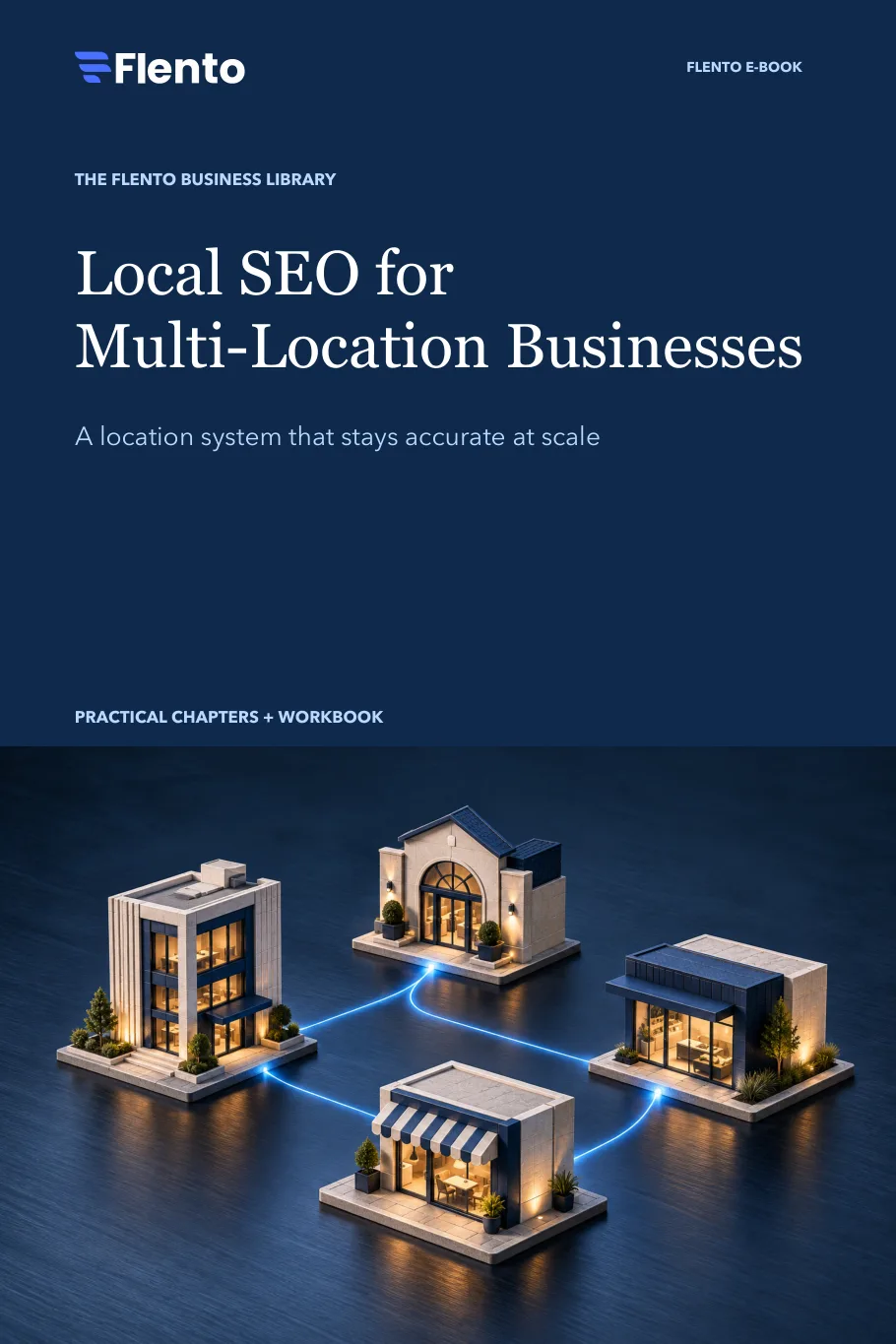
A multi-location program succeeds when shared standards and local reality agree. This book explains how to govern eligible locations, maintain truthful records and compare performance fairly. Build the master register first, then use local owners and verification gates to manage change. Scale refers to the number of real operations you can maintain, not a reason to create ineligible listings or generic city pages.
The route through this ebook
- Standardize.
- Localize.
- Govern.
Use the worksheets digitally in a PDF viewer that supports forms, or print them. Examples are illustrative. Primary references support platform rules; the planning methods are original Flento editorial tools.
The 12 chapters
Each chapter is short on purpose: a clear idea, one thing to do and one worked example. Read one at a time and apply it before moving on.
Chapter 01
Define the location entity
A location is an eligible operation with a real service model, not simply a city on the sales plan. Confirm which sites receive customers and which operations travel to them. Distinguish brands, branches, departments and practitioners using the applicable rules. Keep online-only services out of the profile inventory. The entity definition should be settled before a bulk spreadsheet is filled.
Put it into practice
Write inclusion and exclusion rules for the location register.
Worked idea
Example: a staffed branch enters the register while an unstaffed virtual address does not.
Sources: Business representation and industry rules, Service-area businesses
Chapter 02
Build a master register
Give each eligible operation a stable internal ID and a record of approved business facts. Include the profile reference, website destination, hours owner and operational status. Keep changes traceable so a closure does not silently become a new location. The register should support customer service as well as marketing, with only the access needed for each role.
Put it into practice
Reconcile existing profiles with the physical operating list before adding anything new.
Worked idea
Example: branch L018 links one real operation to its profile and local page, even when a marketing label changes.
Chapter 03
Design ownership that survives turnover
Keep business ownership distinct from day-to-day editing. Record primary ownership, authorized managers and a recovery contact. Agency or regional access should match responsibility. Review access when contracts or staff roles change. A shared password across many branches makes both recovery and accountability harder. Document the handoff procedure before anyone leaves.
Put it into practice
Create an access register with a named approver and an offboarding trigger.
Worked idea
Example: a departing regional manager's permissions are reviewed while the business retains ownership.
Sources: Profile ownership
Chapter 04
Use bulk workflows appropriately
Bulk verification is subject to eligibility requirements and is not automatically available to every group of profiles. Google's guidance describes qualifying groups of ten or more locations of the same business, with exclusions including service-area businesses. Check the current account and business rules before planning a bulk rollout. Prepare consistent evidence and resolve location data issues first.
Put it into practice
Document whether the group qualifies and which process is actually offered.
Worked idea
Example: a chain validates its real locations and categories before submitting a bulk-verification request.
Sources: Bulk verification
Chapter 05
Separate shared and local facts
A brand can standardize names and approved language, while local teams own arrival details, staffed hours and real services. Do not force a centrally imagined offer onto a branch that cannot provide it. Define fields that require central approval and fields that a local owner must verify. A shared template should reduce mistakes, not erase useful local information.
Put it into practice
Create a field-ownership matrix and attach a verification rule to each field.
Worked idea
Example: the brand description is centrally reviewed, but holiday hours require confirmation from each location.
Chapter 06
Make location pages genuinely distinct
Each eligible operation needs a useful destination that answers its customers' questions. Include actual services, contact routes and truthful arrival or coverage information. Replacing a city name in otherwise identical pages adds little value. Keep page hierarchy understandable and avoid doorway patterns that exist mainly to capture similar queries. Local differences should be verified by the branch.
Put it into practice
Ask the local owner to confirm what makes its page useful to its customers.
Worked idea
Example: a branch page names the services available there and provides its direct booking route.
Sources: LocalBusiness structured data, Web search spam policies
Chapter 07
Control changes with a gate
A change request should state the affected locations, approved facts and effective operating context. Test the customer route after updates and record the public result. Mass edits need a way to pause if a wrong fact spreads. Keep the previous approved value for recovery. A field is not considered complete merely because the upload succeeded.
Put it into practice
Use request, approval, update and live-verification stages for meaningful changes.
Worked idea
Example: a phone migration is complete only after test calls reach the correct team at each branch.
Chapter 08
Keep local media truthful
Use branch-specific real photographs when the content represents that branch. A photo from a flagship site can mislead customers at a different location. Track permissions and capture the details customers need, such as entrance recognition. A central asset library needs a location identifier and an owner, so attractive but inaccurate material does not spread through bulk uploads.
Put it into practice
Label each real asset with its location, purpose and permission record.
Worked idea
Example: two branches photograph their own entrances instead of reusing the headquarters image.
Sources: Photos and videos, Maps content policies
Chapter 09
Route feedback to the right team
Choose a review destination and response owner for each operation. Keep invitation wording neutral across the network and avoid branch competitions based on review quotas or star targets. Escalation cases may require central support, while local operational issues need a branch owner. Protect privacy in replies and keep investigations in the approved private system.
Put it into practice
Test branch routing with the local manager and define central escalation triggers.
Worked idea
Example: a complaint about access goes to the branch, while a sensitive data concern receives specialist review.
Sources: Review requests, Maps content policies
Chapter 10
Compare like with like
Group locations by service model, operating maturity and customer context before comparing numbers. A new site, seasonal business and long-established flagship do not start from the same conditions. Use consistent metric definitions and label missing data. Do not pool interactions into a global conversion rate when the denominators describe different journeys. Compare outcomes the business can validate.
Put it into practice
Write the comparison rules and exclusions before preparing a league table.
Worked idea
Example: appointment enquiries are compared among similar service branches, not against hotel booking clicks.
Sources: Profile performance definitions
Chapter 11
Roll out changes in stages
Test a shared change on a small, appropriate set of real locations before wider deployment. Include different operating contexts rather than only the easiest branch. Save the baseline and track local problems. The rollout decision should consider operational reliability and customer impact, with a stop condition for inaccurate information. A pilot is a learning tool, not proof of a universal performance lift.
Put it into practice
Define the pilot group, completion evidence and pause rule before editing.
Worked idea
Example: a new location-page template is tested with a storefront and an eligible service-area operation.
Sources: Profile performance definitions, Service-area businesses
Chapter 12
Run a location governance review
Periodically reconcile the register with openings, closures, ownership changes and service changes. Ask local owners to verify the facts they control. Review exceptions instead of assuming a central dashboard proves accuracy. Keep an action log with responsible people and evidence. The program should make the next necessary update easy to identify and safe to execute.
Put it into practice
Choose one governance owner and a short exception-review routine.
Worked idea
Example: the team identifies a moved branch, validates its current operating status and follows the appropriate update process.
Workbook sheets
The PDF includes four fill-in sheets. Here is what each one asks you to record. Download the PDF to type into them or print them.
Workbook 01
Location master record
One record per eligible operation.
- Stable location ID and profile
- Eligibility and operating model
- Approved name / address / coverage
- Direct contact and local page
- Hours owner and status
- Access and recovery owner
Workbook 02
Field ownership matrix
Choose who approves and who verifies the public result.
- Shared fields and central approver
- Local fields and branch owner
- Evidence required for changes
- Mass-edit pause rule
- Live verification procedure
- Recovery record
Workbook 03
Rollout decision sheet
Test a useful change before expanding it.
- Change and customer purpose
- Pilot locations and selection reason
- Baseline evidence
- Local completion tests
- Stop / expand decision rule
- Exceptions and next action
Workbook 04
Comparable location review
Avoid misleading pooled rates or rankings.
- Comparable location group
- Metric definitions
- Operating-context differences
- Missing data and exclusions
- Validated business outcomes
- Decisions for local owners
Sources
Official documentation supports platform rules. The examples, routines and worksheets are Flento editorial tools. Links open the publishers' own pages. Check them for the current version, since platform documentation changes.
- Business representation and industry rules · Google (opens in a new tab)
- Bulk verification · Google (opens in a new tab)
- Photos and videos · Google (opens in a new tab)
- Profile performance definitions · Google (opens in a new tab)
- Web search spam policies · Google (opens in a new tab)
- Product and free signup · Flento (opens in a new tab)
- Service-area businesses · Google (opens in a new tab)
- Profile ownership · Google (opens in a new tab)
- Review requests · Google (opens in a new tab)
- LocalBusiness structured data · Google (opens in a new tab)
- Maps content policies · Google (opens in a new tab)
Global scope: apply the platform guidance to an eligible business. Local operating requirements, customer expectations and feature availability may differ. This publication makes no guaranteed performance or ranking claims.