What this report says, and what it does not
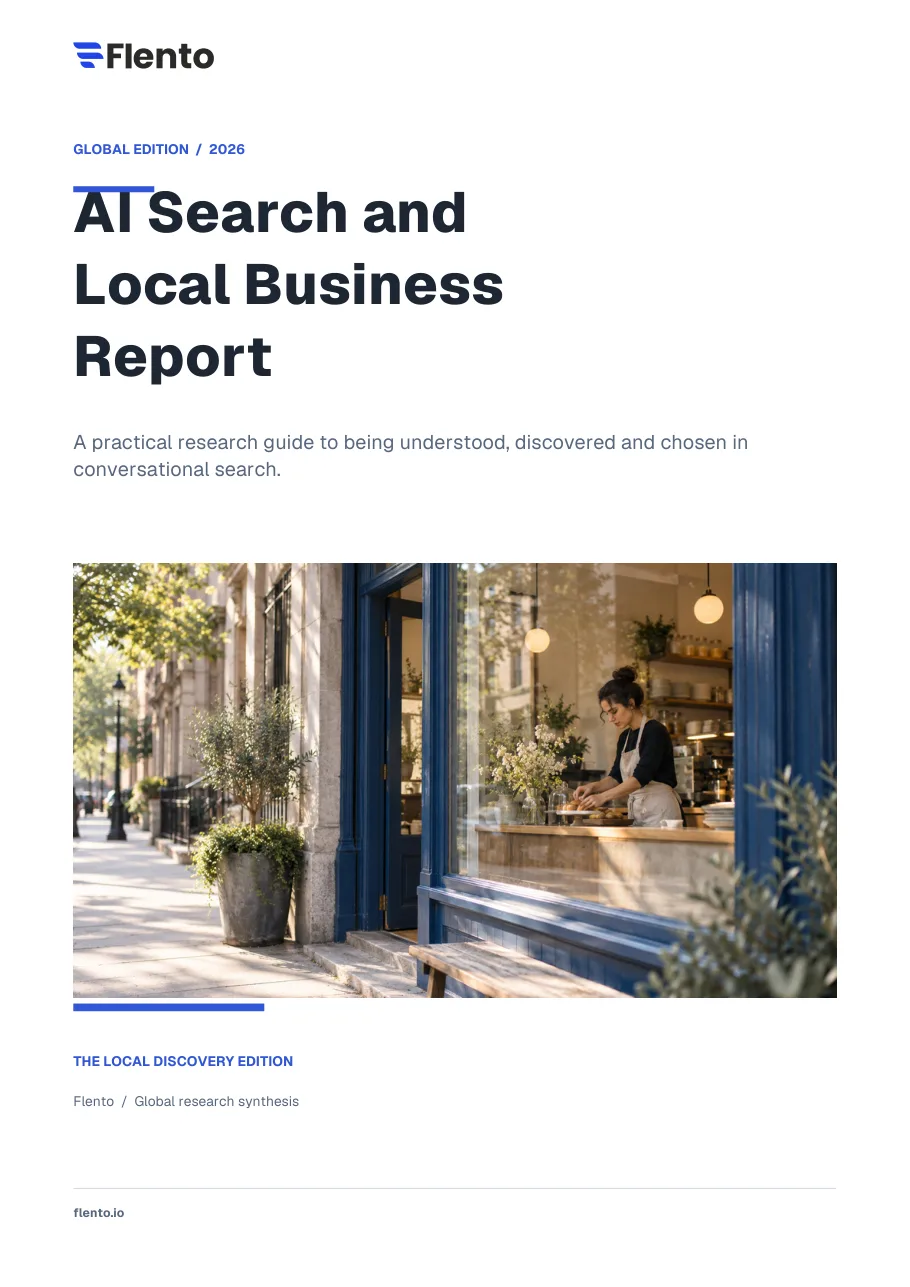
Customers can now ask longer questions, compare options and refine what they need before they ever visit a website. This report asks what that means for a local business, and answers only with what platforms publish and what bounded research has measured.
It covers four discovery experiences (Google AI Overviews, Google AI Mode, ChatGPT search and Microsoft's AI products), shows how Google, OpenAI and Microsoft document access and reporting, and sets out a repeatable way to observe and measure AI visibility without over-claiming.
The report is deliberately cautious. No platform documentation guarantees that a business will be recommended, and the report claims no worldwide AI market share and no guaranteed ranking lift.
Key facts at a glance
- 8% vs 15% Result clicks, with and without an AI summary. Pew Research Center, 2025, US browsing records.
This report does
- Summarises what Google, OpenAI and Microsoft document about AI search features, crawler controls and reporting.
- Reports a US browsing study from Pew with its sample size and scope next to the figure.
- Offers Flento's own operating frameworks, labelled as recommendations.
This report does not
- Report an original Flento survey or a global dataset.
- Claim a worldwide AI adoption rate or market share.
- Claim that any tactic guarantees an AI citation or recommendation.
Scope. Global framework. The one consumer study cited, from Pew, sampled US adults only.
Key findings
Each finding shows who measured it and what it covers. The tag shows the kind of evidence behind it: platform documentation, a third-party study, a Flento framework or a synthetic example.
8% vs 15%
Result clicks, with and without an AI summary
Pew Research Center observed that traditional search results received 8% of visits when a Google AI summary appeared, against 15% when none appeared. Pew analysed 68,879 Google searches from the browsing records of 900 US adults. The shares cover all searches, not only local ones, and are not a causal estimate of local-business traffic loss.
Scope: Pew Research Center, 2025, US browsing records
Source:Pew Research Center: AI summaries and clicks (opens in a new tab)
Four discovery surfaces, four kinds of reporting
Google AI Overviews, Google AI Mode, ChatGPT search and Microsoft AI each work differently and report differently. The report advises assessing features and controls within each platform instead of treating AI search as one channel. A source link is not a guaranteed position or customer outcome.
Scope: Google, OpenAI and Microsoft documentation
Sources:Google: AI features and website discovery (opens in a new tab)OpenAI: Search and training crawler controls (opens in a new tab)Microsoft Bing: AI Performance (opens in a new tab)
No special AI markup or file is required, according to Google
The report notes that Google says no special AI schema or llms.txt file is required. Structured data may support search understanding and eligibility for certain displays, but it does not guarantee an AI citation.
Scope: Google Search Central documentation
Sources:Google: Optimizing for generative AI search (opens in a new tab)Google: LocalBusiness structured data (opens in a new tab)
Search access and training access are separate OpenAI controls
OpenAI documents separate crawlers for separate purposes: OAI-SearchBot for search discovery, GPTBot for potential model-training content, and ChatGPT-User for user-triggered requests. Blocking OAI-SearchBot can affect search answers, while navigational links can still appear. The report recommends confirming the intended policy with the site owner.
Scope: OpenAI crawler documentation
Source:OpenAI: Search and training crawler controls (opens in a new tab)
Google and Bing count different events
Google Search Console's generative AI performance report links impressions in supported AI Overviews and AI Mode experiences. Bing Webmaster Tools' AI Performance report cites pages, total citations and grounding-query context. Neither is a complete worldwide count of unlinked brand mentions or confirmed customers.
Scope: Google and Microsoft reporting documentation
Sources:Google: Generative AI performance report (opens in a new tab)Microsoft Bing: AI Performance (opens in a new tab)Microsoft Advertising: AI Performance dashboard (opens in a new tab)
A mention is not a citation, a visit or a sale
The report separates four units that are often blurred: being named in an answer (mention), being linked as a source (citation), a website session (visit) and an enquiry, booking or sale (outcome). Each needs its own record and interpretation.
Scope: Flento measurement framework
Charts and figures
Each figure is labelled as reported data, a synthetic example or a conceptual illustration. Synthetic and conceptual figures are not measurements.
Traditional-result click share of observed visits
Pew Research Center, 68,879 Google searches from the browsing records of 900 US adults, 2025.
- AI summary appeared8%
- No AI summary appeared15%
Read this correctly. These observed shares are not a randomized causal estimate of local-business traffic loss. The sample covers all searches, not only local queries.
Source:Pew Research Center: AI summaries and clicks (opens in a new tab)
The main AI discovery surfaces and what to check on each
Availability and response composition vary by platform and market.
| Surface | What it does | What to check |
|---|---|---|
| Google AI Overviews | Summary in Search | Supporting links |
| Google AI Mode | Exploration and comparisons | Answer and citations |
| ChatGPT search | Search inside an assistant | OAI-SearchBot access |
| Microsoft AI | Copilot, Bing and partners | Citation reporting |
Read this correctly. A source link is not a guaranteed position or customer outcome.
Sources:Google: AI features and website discovery (opens in a new tab)OpenAI: Search and training crawler controls (opens in a new tab)Microsoft Bing: AI Performance (opens in a new tab)
OpenAI crawlers and the choice each one represents
Crawler definitions and current behaviour are set by OpenAI. Confirm the intended policy with the site owner.
| Crawler | Purpose | Operational choice |
|---|---|---|
| OAI-SearchBot | Automated search discovery | Allow intended access in robots.txt and network controls |
| GPTBot | Potential model-training content | A separate training-policy decision |
| ChatGPT-User | User-triggered requests | Not the control for Search inclusion |
Source:OpenAI: Search and training crawler controls (opens in a new tab)
Google Search Console and Bing Webmaster Tools report different things
Read each platform's unit before comparing it with traffic or outcomes.
| Google Search Console | Bing Webmaster Tools | |
|---|---|---|
| Report | Generative AI performance report | AI Performance |
| What it counts | Impressions in supported AI Overviews and AI Mode experiences | Cited pages, total citations and grounding-query context across supported experiences |
| Check | Page, country, device, filters and aggregation. Property totals and page totals can differ. | Page-level activity and the documented scope. Citation measures are not ranking or authority scores. |
Read this correctly. Neither report is a complete worldwide count of unlinked brand mentions or confirmed customers.
Sources:Google: Generative AI performance report (opens in a new tab)Microsoft Bing: AI Performance (opens in a new tab)Microsoft Advertising: AI Performance dashboard (opens in a new tab)
The visibility-to-outcome chain
A conceptual framework from Flento. It shows four units to keep separate, not a measured funnel.
Mention
Named in an answer
Citation
Linked as a source
Visit
Website session
Outcome
Enquiry, booking or sale
Read this correctly. A citation is not a visit. A mention is not a sale.
An audit rate is only as broad as its test set
Synthetic worked example. These numbers were invented to show the arithmetic and are not measured Flento or market performance.
3
mentions
12
valid observations
3 of 12
Report the prompt set, repeats, platform and location conditions. Keep failed runs outside the valid denominator.
Read this correctly. This rate is not market share or a universal customer probability.
What to do with the evidence
These are Flento's editorial recommendations. They follow from the report, but they are not findings and not guarantees of results.
- Make five facts reliable at every location. Identity, service, access, timing and a working enquiry route. Audit these before scaling content or testing AI visibility.
- Answer real customer questions on a relevant page. Collect questions from enquiries and reception notes, then publish a specific answer with a clear next step. The report advises against a thin page for every wording variation.
- Record every observation. Save the exact prompt, the platform and search mode, the language, location and account context, and the result. A single response cannot establish a stable global ranking.
- Verify before you publish AI-assisted drafts. Use AI to organise real information, then check every material claim. The report warns against scaled, repetitive pages made mainly to manipulate search.
- Run a 30-day cycle. Days 1 to 7: audit facts. Days 8 to 14: fix gaps. Days 15 to 30: assess reports, repeat observations and outcomes, then decide which improvement had a verified customer benefit.
Methodology and limitations
How the report was built
The report is a global desk-research synthesis. It combines three evidence classes: platform documentation from Google, OpenAI and Microsoft, which defines supported behaviour, controls and reporting units; a US research source (Pew Research Center); and Flento's own frameworks.
The audit, content example, manual observation protocol and 30-day action plan are Flento recommendations. The 3-of-12 audit rate is synthetic.
The Pew figures are reproduced from that publisher. Conceptual illustrations, such as the query fan-out and service-area schematics in the PDF, are not measurements.
Limitations
- The Pew study sampled US adults. It is neither a global nor a local-business-specific sample.
- The Pew shares cover all Google searches in the sample, not only local searches, and are observational, not causal.
- No country-by-country AI adoption, local lead volume or market share is inferred.
- Platform features, controls and reporting change. Check current documentation before changing any setting.
Sources
Links open the publishers' own pages. Check them for the current version, since platform documentation changes.
- AI features and website discovery · Google (opens in a new tab)
- Optimizing for generative AI search · Google (opens in a new tab)
- Search generative AI control · Google (opens in a new tab)
- Generative AI performance report · Google (opens in a new tab)
- LocalBusiness structured data · Google (opens in a new tab)
- Search spam policies · Google (opens in a new tab)
- Localized website versions · Google (opens in a new tab)
- Generative AI content guidance · Google (opens in a new tab)
- Local ranking guidance · Google (opens in a new tab)
- Search and training crawler controls · OpenAI (opens in a new tab)
- AI Performance · Microsoft Bing (opens in a new tab)
- AI Performance dashboard · Microsoft Advertising (opens in a new tab)
- AI summaries and clicks · Pew Research Center (opens in a new tab)
Cite this report
Reed, K. (2026, October 19). AI Search and Local Business Report. Flento Research. https://www.flento.io/downloadables/report/ai-search-and-local-business
Journalists, researchers and publishers are welcome to quote this report and use its figures. Please attribute them to Flento Research; a link to this page is appreciated but not required.
Third-party figures belong to their original publishers. When you use one, attribute it to the publisher named beside it, such as Pew Research Center or Google.
Canonical page: https://www.flento.io/downloadables/report/ai-search-and-local-business