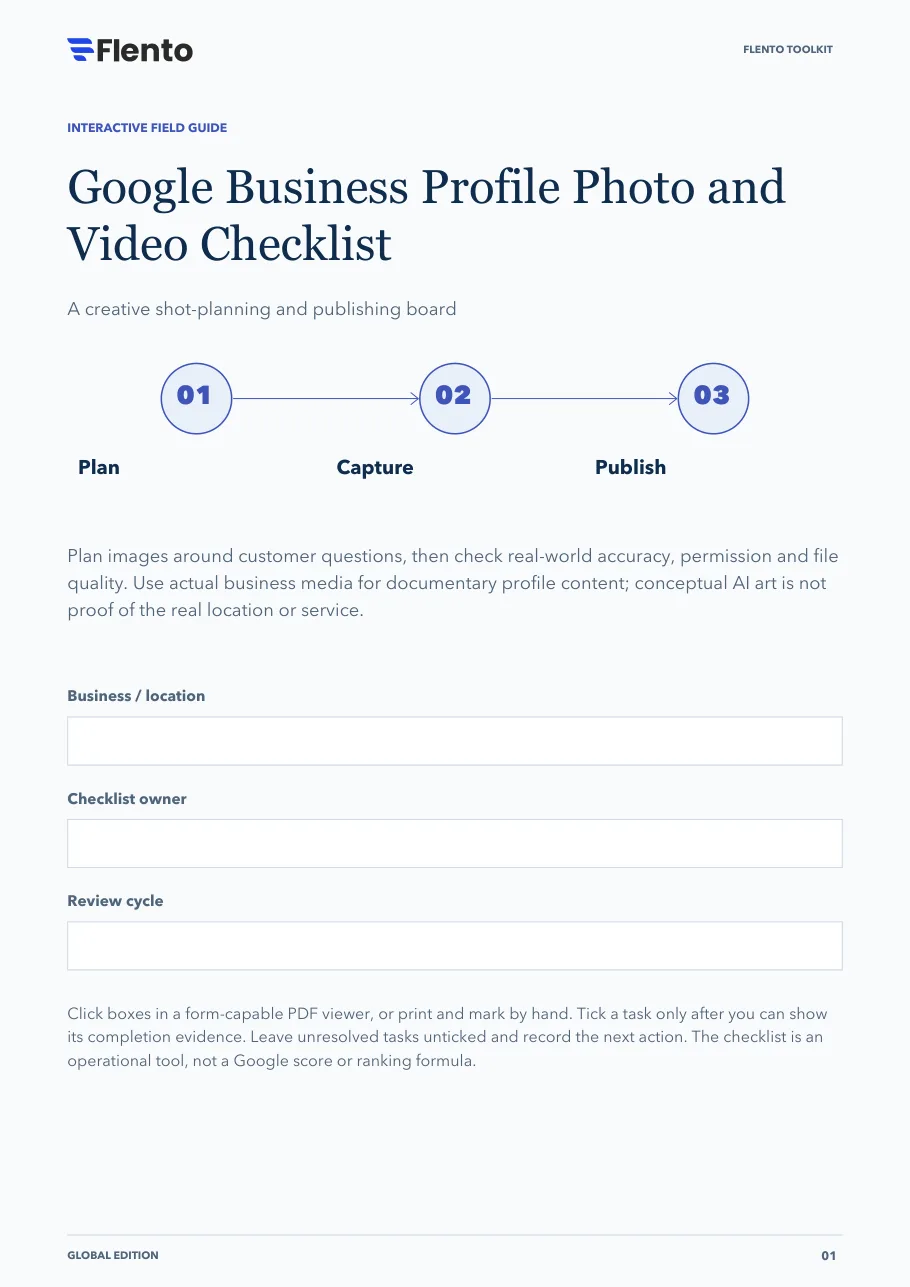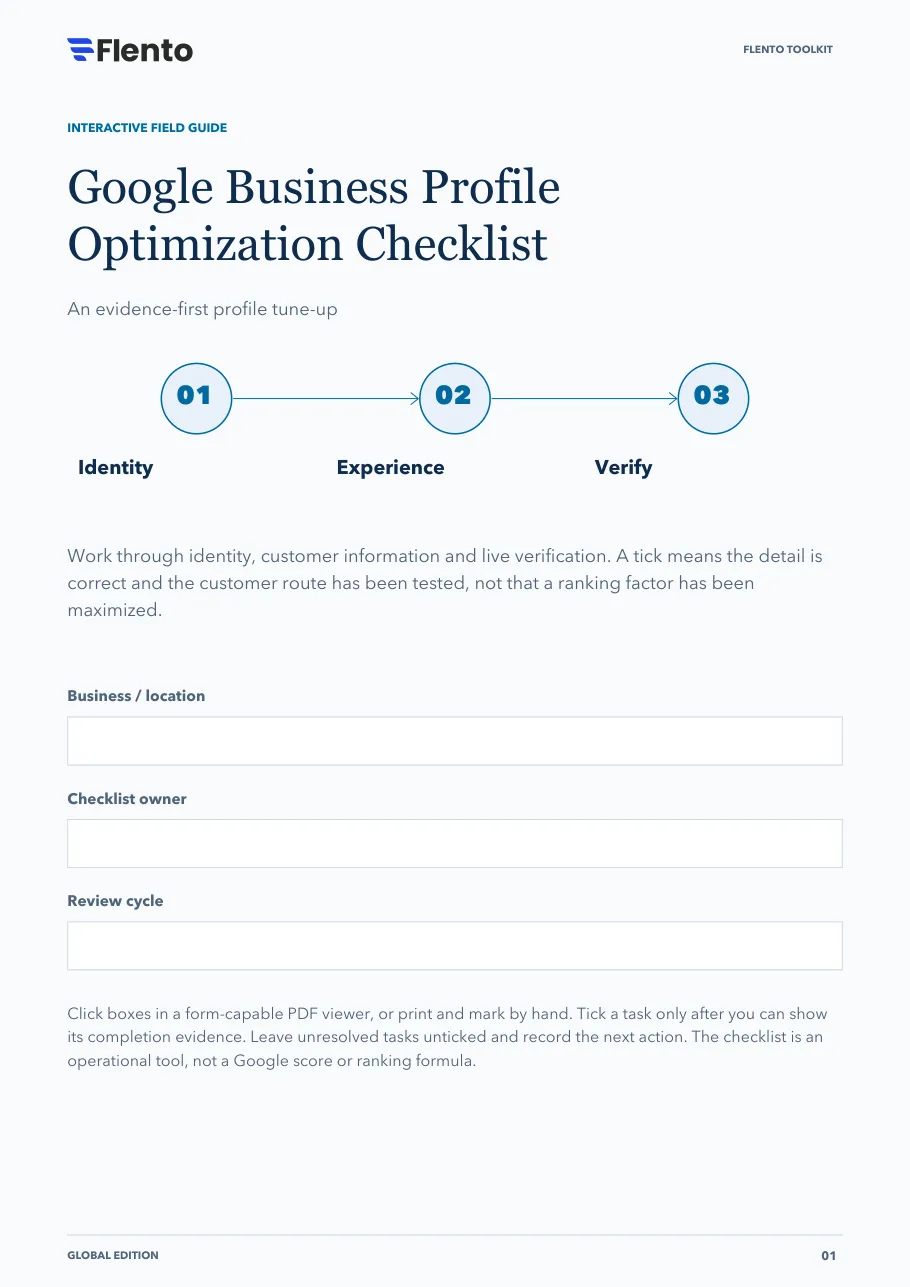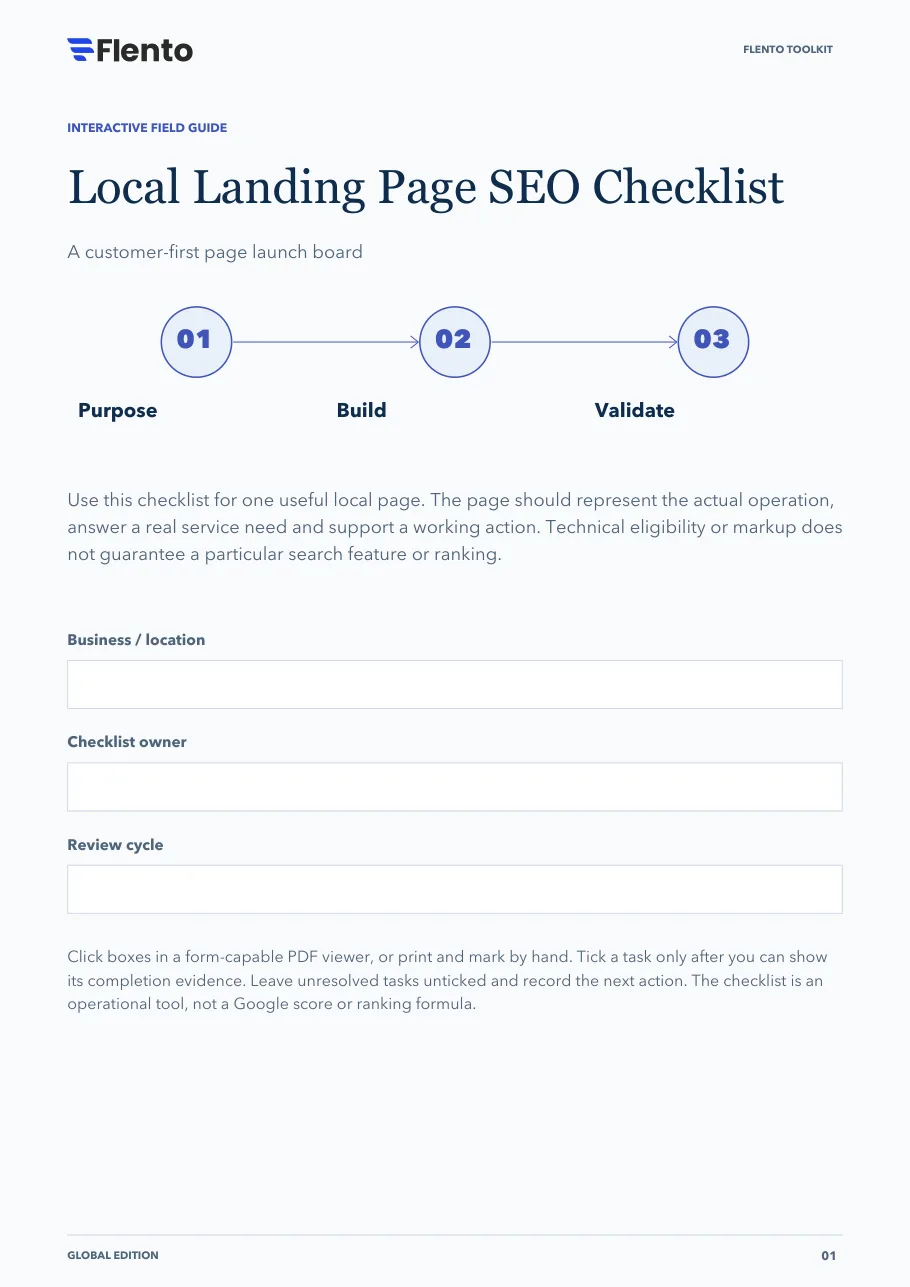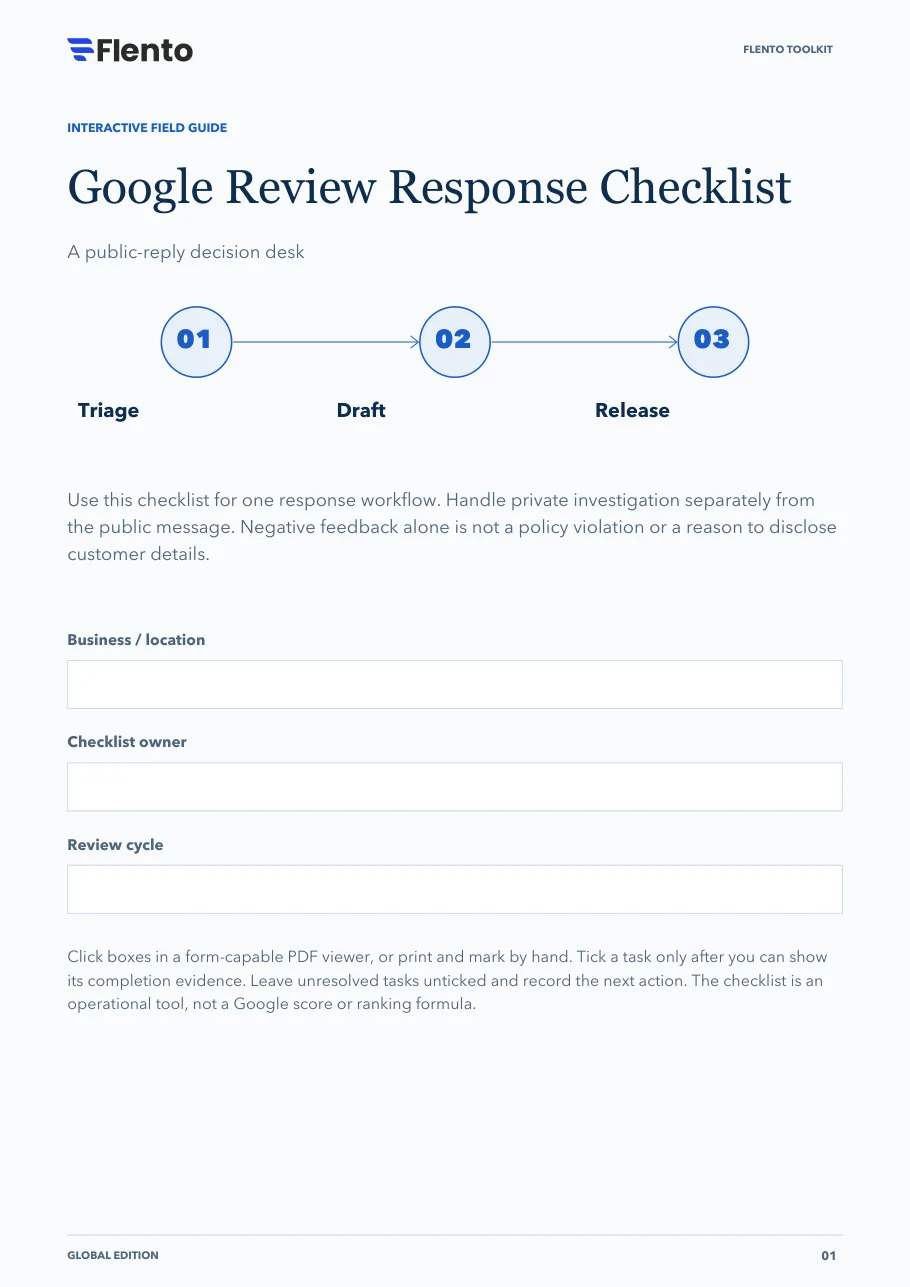
How to use this checklist
Use this checklist for one response workflow. Handle private investigation separately from the public message. Negative feedback alone is not a policy violation or a reason to disclose customer details.
The 3 stages
- Triage.
- Draft.
- Release.
Click boxes in a form-capable PDF viewer, or print and mark by hand. Tick a task only after you can show its completion evidence. Leave unresolved tasks unticked and record the next action. The checklist is an operational tool, not a Google score or ranking formula.
The PDF also has fields at the top for the business or location, the checklist owner and the review cycle.
Stage 1: Understand and route the review
Decide what the response team can safely handle.
Read the full public concern
Evidence: The issue is summarized without speculation.
Separate service feedback from a possible policy issue
Evidence: A specific policy reason is recorded if reporting is considered.
Identify sensitive or private information
Evidence: Details that must not be repeated publicly are marked.
Assign the appropriate case owner
Evidence: Routine or specialist ownership is clear.
Check any operational facts needed for a reply
Evidence: The responsible team confirms what can be stated.
Route urgent concerns through private support
Evidence: An approved business channel and escalation route exist.
Stage decision
Pause drafting if facts, privacy or authorized ownership are unclear. Reporting a review and serving the customer are separate workflows.
Sources: Review requests, Maps content policies
Stage 2: Draft a helpful public reply
Be brief, relevant and grounded in what is safe to say.
Acknowledge the concern without a personal attack
Evidence: The wording is calm and relevant.
Use only verified public-safe details
Evidence: No private relationship or case information is exposed.
Remove unsupported promises or invented investigations
Evidence: Every commitment has an authorized owner.
Offer an appropriate private contact when needed
Evidence: The channel can actually handle the concern.
Avoid promotional copy and repetitive boilerplate
Evidence: The reply addresses this review's issue.
Check any AI draft against the source and facts
Evidence: A person validates tone, accuracy and privacy.
Stage decision
A polished draft is not approval. Sensitive replies must wait for the designated owner.
Sources: Review requests, Maps content policies, Generative AI content
Stage 3: Approve, publish and follow through
The public reply should connect to a real internal action.
Confirm the required reviewer has approved
Evidence: Approver and final wording recorded.
Verify the correct location and review thread
Evidence: No reply is posted to the wrong business or case.
Publish only the approved response
Evidence: The live wording matches the reviewed draft.
Keep case details in the private system
Evidence: Public notes contain no sensitive customer records.
Assign follow-through on any promised action
Evidence: The operational owner has a clear next task.
Log recurring themes for service improvement
Evidence: Learning is separated from assumptions about all customers.
Stage decision
Close the response task only when publication and internal follow-through are assigned. Do not offer benefits for revising or removing a review.
Sources: Review requests, Maps content policies
Your next move
Use this sheet for the most important unresolved item. Keep customer records out of this public-facing workbook.
- Unresolved task / blocker
- Responsible owner
- Completion evidence needed
- Next action and review trigger
Sources
Links open the publishers' own pages. Check them for the current version, since platform documentation changes.
- Review requests · Google (opens in a new tab)
- Maps content policies · Google (opens in a new tab)
- Generative AI content · Google (opens in a new tab)
- Product and free signup · Flento (opens in a new tab)
References are clickable. Tasks, stage decisions and layouts are original Flento planning tools; availability and industry rules vary.