How to use this checklist
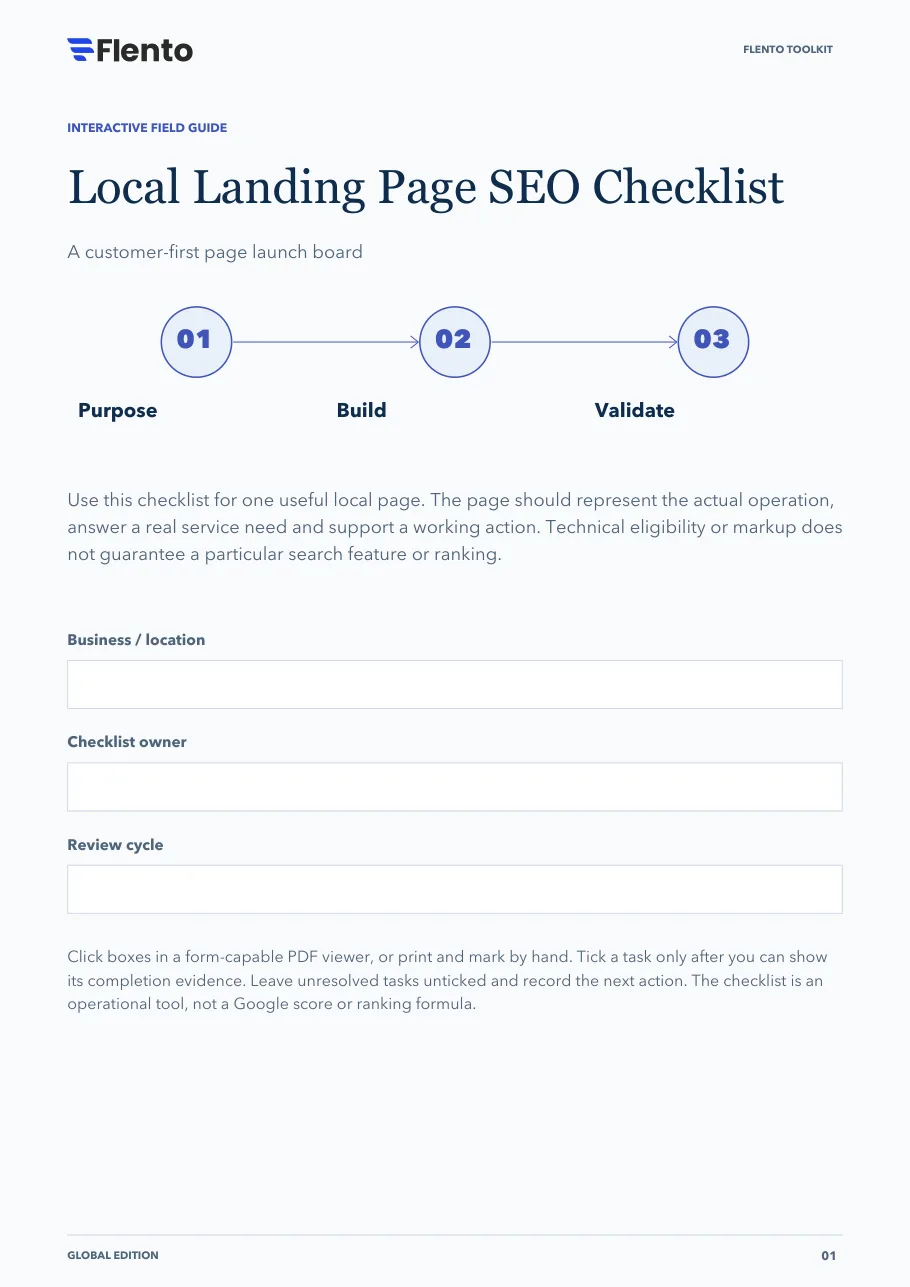
Use this checklist for one useful local page. The page should represent the actual operation, answer a real service need and support a working action. Technical eligibility or markup does not guarantee a particular search feature or ranking.
The 3 stages
- Purpose.
- Build.
- Validate.
Click boxes in a form-capable PDF viewer, or print and mark by hand. Tick a task only after you can show its completion evidence. Leave unresolved tasks unticked and record the next action. The checklist is an operational tool, not a Google score or ranking formula.
The PDF also has fields at the top for the business or location, the checklist owner and the review cycle.
Stage 1: Define the page's real purpose
Choose distinct customer value before writing the page.
Identify the actual location or eligible service coverage
Evidence: The page's place claims match operations.
Choose the main customer need and service
Evidence: A specific question or action is documented.
Confirm approved identity, hours and contact details
Evidence: The business fact owner has checked them.
Gather genuine local proof and useful arrival details
Evidence: Evidence belongs to this operation.
Plan distinct information rather than a city-name swap
Evidence: The page adds real customer value.
Choose an accountable content and service owner
Evidence: Both factual maintenance and enquiry handling are assigned.
Stage decision
Pause if the page implies a location that does not exist or has no distinct customer purpose. Avoid doorway-style city-page expansion.
Sources: Business representation and industry rules, Service-area businesses, Web search spam policies
Stage 2: Build a usable customer route
Make the service and next step clear on a phone.
Write a clear title and main service explanation
Evidence: The page tells customers what they can actually receive.
Show factual location or coverage information as text
Evidence: Important details are not only embedded in images.
Use real permissioned media and appropriate descriptions
Evidence: Visuals clarify the actual operation.
Provide a direct call, enquiry or booking route
Evidence: The intended action is visible and understandable.
Keep visible facts consistent with any structured data
Evidence: Supported LocalBusiness information matches the page.
Check mobile readability and interaction
Evidence: Text, buttons and form controls are usable on a phone.
Stage decision
A usable page serves customers first. Do not hide important facts or stuff the page with repeated place names.
Sources: LocalBusiness structured data, Web search spam policies, Photos and videos
Stage 3: Validate and maintain
Inspect the complete route after release, not only the page preview.
Check crawl and indexing controls with the web team
Evidence: The intended public page is not accidentally blocked.
Validate applicable structured data
Evidence: Errors are corrected; rich-result eligibility is not a guarantee.
Test the final URL and redirects from the profile
Evidence: The customer reaches the intended local page.
Submit a harmless test enquiry or booking
Evidence: The correct team confirms receipt and handling.
Verify campaign tags and outcome definitions
Evidence: No private customer details enter URL parameters.
Assign triggers for factual updates and route retests
Evidence: Service, contact or location changes trigger review.
Stage decision
Launch completion requires a working customer handoff. Measure validated outcomes separately from profile website clicks.
Sources: LocalBusiness structured data, Campaign URL measurement, Profile performance definitions
Your next move
Use this sheet for the most important unresolved item. Keep customer records out of this public-facing workbook.
- Unresolved task / blocker
- Responsible owner
- Completion evidence needed
- Next action and review trigger
Sources
Links open the publishers' own pages. Check them for the current version, since platform documentation changes.
- Business representation and industry rules · Google (opens in a new tab)
- Service-area businesses · Google (opens in a new tab)
- Web search spam policies · Google (opens in a new tab)
- LocalBusiness structured data · Google (opens in a new tab)
- Photos and videos · Google (opens in a new tab)
- Campaign URL measurement · Google (opens in a new tab)
- Profile performance definitions · Google (opens in a new tab)
- Product and free signup · Flento (opens in a new tab)
References are clickable. Tasks, stage decisions and layouts are original Flento planning tools; availability and industry rules vary.