How to use this checklist
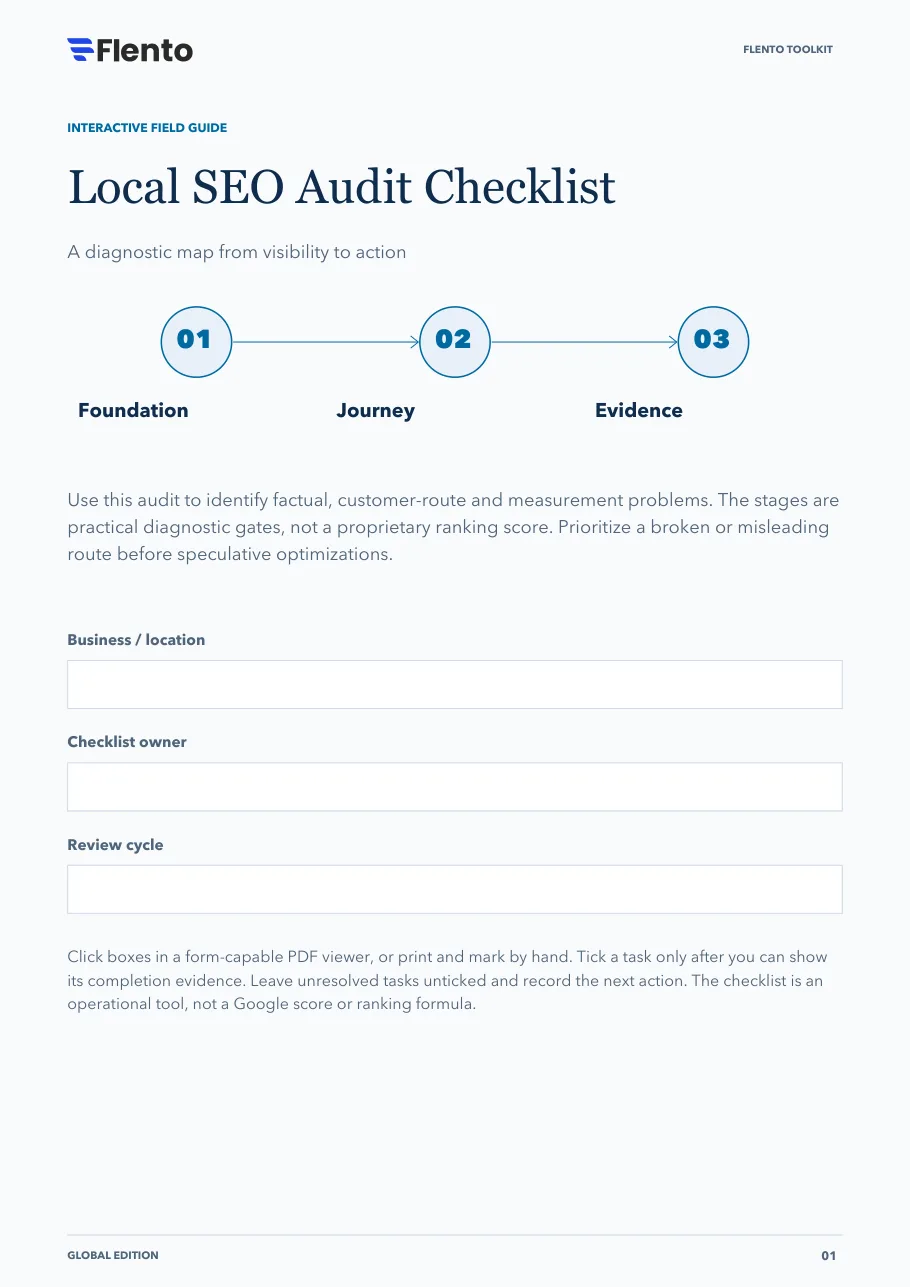
Use this audit to identify factual, customer-route and measurement problems. The stages are practical diagnostic gates, not a proprietary ranking score. Prioritize a broken or misleading route before speculative optimizations.
The 3 stages
- Foundation.
- Journey.
- Evidence.
Click boxes in a form-capable PDF viewer, or print and mark by hand. Tick a task only after you can show its completion evidence. Leave unresolved tasks unticked and record the next action. The checklist is an operational tool, not a Google score or ranking formula.
The PDF also has fields at the top for the business or location, the checklist owner and the review cycle.
Stage 1: Audit the foundation
Check that the public presence represents the real business.
Confirm eligibility and actual operating model
Evidence: Inclusion reason and any sector exception recorded.
Inventory existing profiles and ownership
Evidence: Duplicate and access issues identified.
Compare core facts with approved business records
Evidence: Name, phone, address or coverage verified.
Review category and actual service fit
Evidence: Selections match the operation's genuine activities.
Check hours against service availability
Evidence: Regular and special-hour promises are accurate.
Inspect important directory records
Evidence: Useful customer routes have current identity details.
Stage decision
Escalate eligibility, access or misleading-information problems before routine content work.
Sources: Business representation and industry rules, Service-area businesses, Profile ownership
Stage 2: Audit the customer journey
Test the route instead of relying on attractive screenshots.
Check real media and arrival or coverage clarity
Evidence: A first-time customer understands the service context.
Test call and website buttons on mobile
Evidence: The intended team and page are reachable.
Complete a harmless enquiry or booking test
Evidence: Receipt by the correct operation is confirmed.
Review local-page service answers and proof
Evidence: The page offers distinct useful information.
Check reviews, replies and invitation neutrality
Evidence: No pressure, rewards or satisfaction filtering found.
Inspect live posts and promised next steps
Evidence: Current details and relevant destinations verified.
Stage decision
Record friction in the customer terms: what they expected, what happened and what needs correcting.
Sources: Photos and videos, Review requests, Maps content policies, Business Profile posts, LocalBusiness structured data
Stage 3: Audit measurement and priorities
Choose a verifiable action from the evidence.
Confirm the definitions of available profile metrics
Evidence: Interactions and business outcomes are distinguished.
Check website campaign tags and privacy
Evidence: Names are consistent and contain no customer details.
Validate the business-outcome source
Evidence: The handling team confirms enquiries, bookings or orders.
Record limits of visibility observations
Evidence: Query, area and context accompany results.
Prioritize by customer impact and effort
Evidence: Urgent factual fixes are separated from experiments.
Assign one next action with completion evidence
Evidence: Owner, proof and review trigger recorded.
Stage decision
An audit ends with an accountable action plan. Do not manufacture algorithm weights or infer sales from profile clicks.
Sources: Profile performance definitions, Campaign URL measurement, Local ranking guidance
Your next move
Use this sheet for the most important unresolved item. Keep customer records out of this public-facing workbook.
- Unresolved task / blocker
- Responsible owner
- Completion evidence needed
- Next action and review trigger
Sources
Links open the publishers' own pages. Check them for the current version, since platform documentation changes.
- Business representation and industry rules · Google (opens in a new tab)
- Service-area businesses · Google (opens in a new tab)
- Profile ownership · Google (opens in a new tab)
- Photos and videos · Google (opens in a new tab)
- Review requests · Google (opens in a new tab)
- Maps content policies · Google (opens in a new tab)
- Business Profile posts · Google (opens in a new tab)
- LocalBusiness structured data · Google (opens in a new tab)
- Profile performance definitions · Google (opens in a new tab)
- Campaign URL measurement · Google (opens in a new tab)
- Local ranking guidance · Google (opens in a new tab)
- Product and free signup · Flento (opens in a new tab)
References are clickable. Tasks, stage decisions and layouts are original Flento planning tools; availability and industry rules vary.