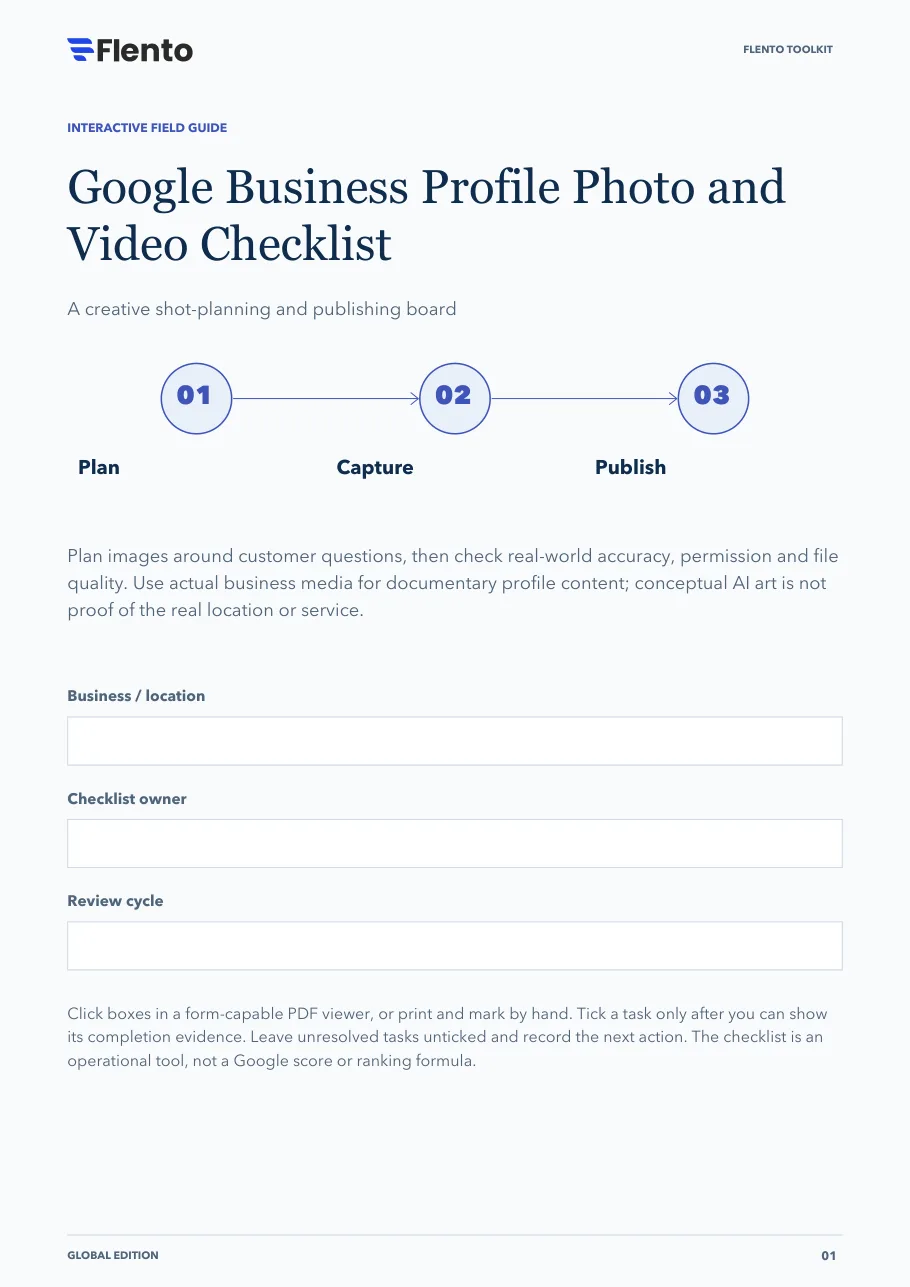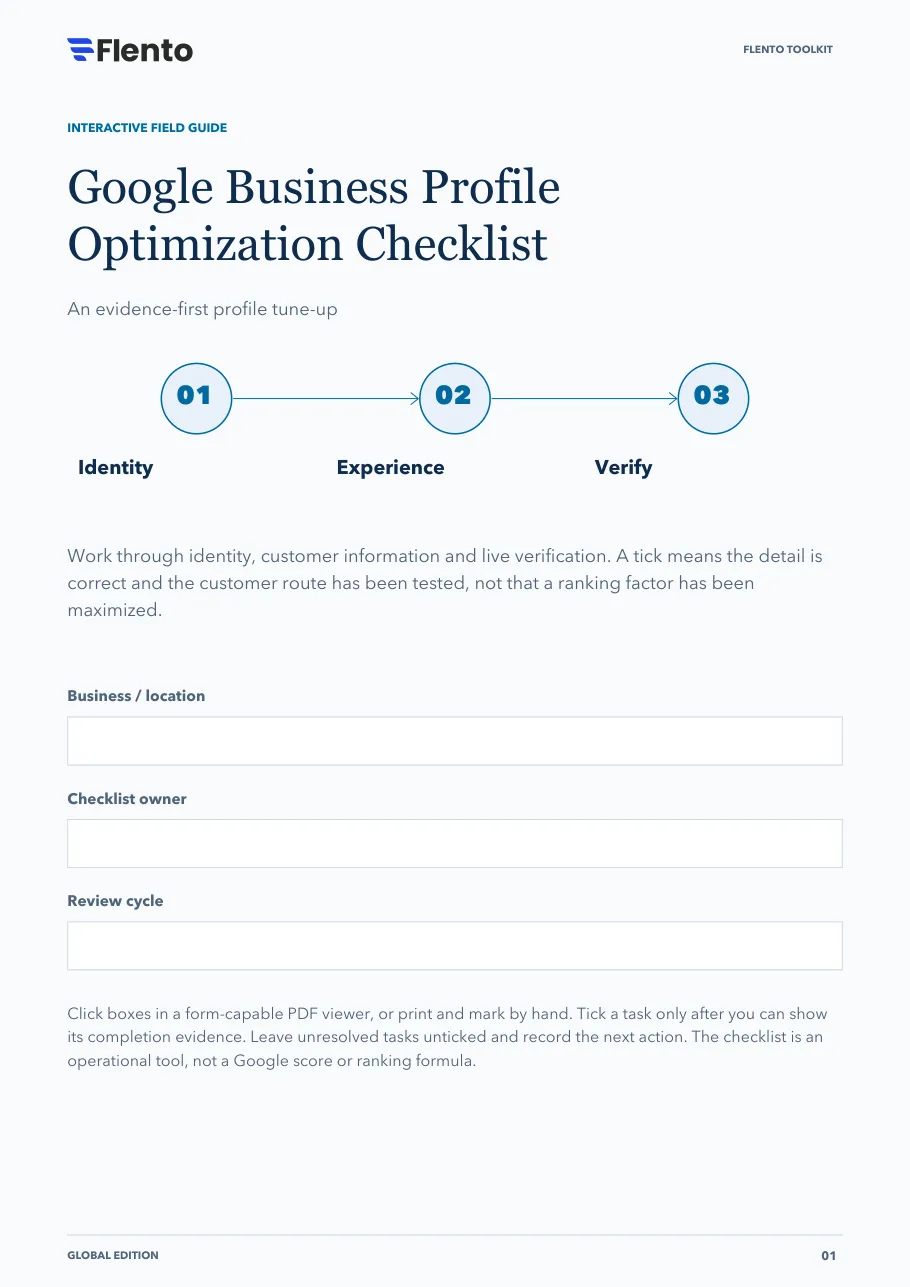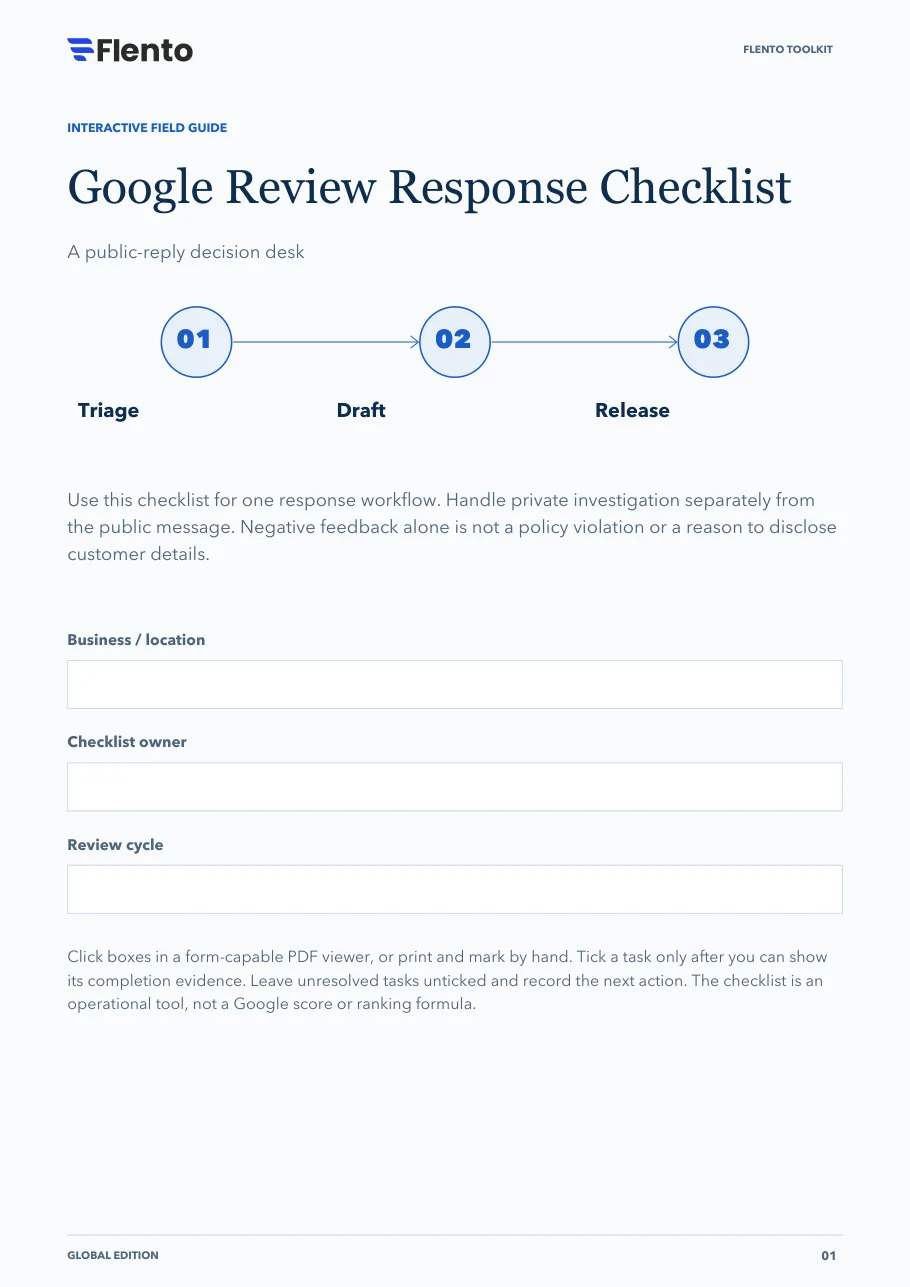
How to use this checklist
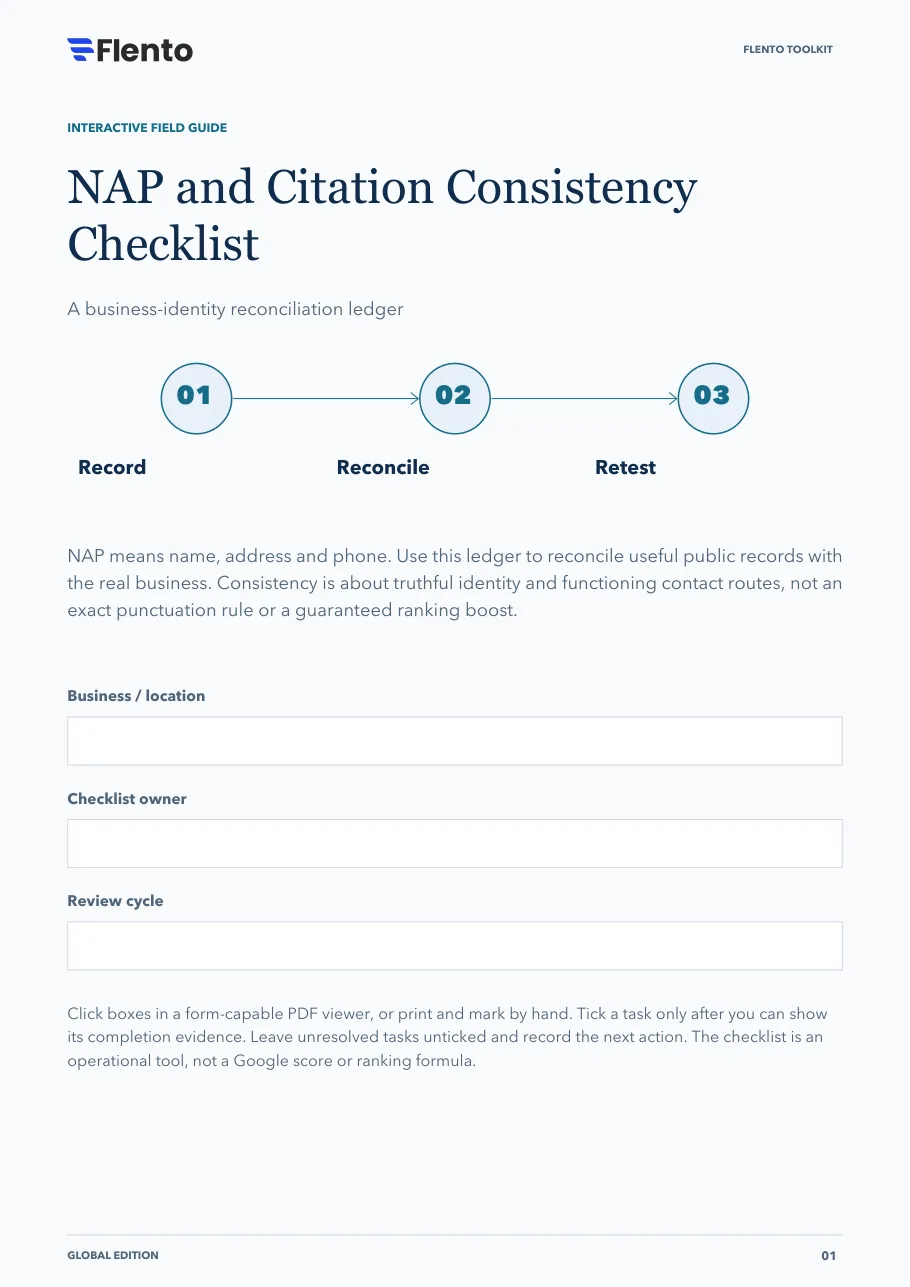
NAP means name, address and phone. Use this ledger to reconcile useful public records with the real business. Consistency is about truthful identity and functioning contact routes, not an exact punctuation rule or a guaranteed ranking boost.
The 3 stages
- Record.
- Reconcile.
- Retest.
Click boxes in a form-capable PDF viewer, or print and mark by hand. Tick a task only after you can show its completion evidence. Leave unresolved tasks unticked and record the next action. The checklist is an operational tool, not a Google score or ranking formula.
The PDF also has fields at the top for the business or location, the checklist owner and the review cycle.
Stage 1: Establish the approved identity
Get the facts from the operation that serves customers.
Confirm the real-world business name
Evidence: Approved name matches actual branding.
Document the correct address or service-area model
Evidence: No ineligible virtual address is treated as a branch.
Confirm the direct business phone
Evidence: A test call reaches the intended team.
Confirm the local website destination
Evidence: The page matches the operation and customer need.
Assign the identity record owner
Evidence: One person can approve factual changes.
Record moves, closures or rebrands requiring attention
Evidence: Operational change context retained.
Stage decision
Do not correct records toward an inaccurate master value. Settle the actual business facts before editing directories.
Sources: Business representation and industry rules, Service-area businesses
Stage 2: Reconcile the useful records
Prioritize properties customers and relevant communities actually use.
Inventory the important public records
Evidence: URLs and record owners captured.
Compare identity and contact routes with the master
Evidence: Meaningful discrepancies identified.
Mark duplicates separately from simple errors
Evidence: A duplicate is not treated as a new location.
Check access and authorized edit routes
Evidence: Ownership or correction process is known.
Prioritize wrong phones, locations and operating states
Evidence: Customer-impacting errors are handled first.
Avoid low-quality link or directory schemes
Evidence: No paid ranking-link shortcut is part of the plan.
Stage decision
Record what the discrepancy means to a customer. Harmless formatting differences do not require the same priority as a wrong phone or address.
Sources: Business representation and industry rules, Web search spam policies
Stage 3: Correct and verify
Track the public result of each authorized correction.
Submit the approved correction through the proper route
Evidence: Request and responsible owner recorded.
Check whether the change is actually public
Evidence: Live record inspected after processing.
Test the updated phone and website links
Evidence: Contact routes function as intended.
Verify duplicate-resolution outcomes
Evidence: The intended entity remains accurately represented.
Update the change log with completion evidence
Evidence: Before and after records are retained internally.
Set a change-triggered recheck rule
Evidence: Moves, rebrands and phone changes trigger review.
Stage decision
Finish when the customer-facing record is accurate. An edit request without a live check remains unresolved.
Your next move
Use this sheet for the most important unresolved item. Keep customer records out of this public-facing workbook.
- Unresolved task / blocker
- Responsible owner
- Completion evidence needed
- Next action and review trigger
Sources
Links open the publishers' own pages. Check them for the current version, since platform documentation changes.
- Business representation and industry rules · Google (opens in a new tab)
- Service-area businesses · Google (opens in a new tab)
- Web search spam policies · Google (opens in a new tab)
- Product and free signup · Flento (opens in a new tab)
References are clickable. Tasks, stage decisions and layouts are original Flento planning tools; availability and industry rules vary.